

The Dow Jones Industrial Average (DJIA) knocked lower on Tuesday, following the broader market into the low side. Investors are reconsidering their disregard for the US government shutdown that has dragged into its second week and shows no signs of resolution.
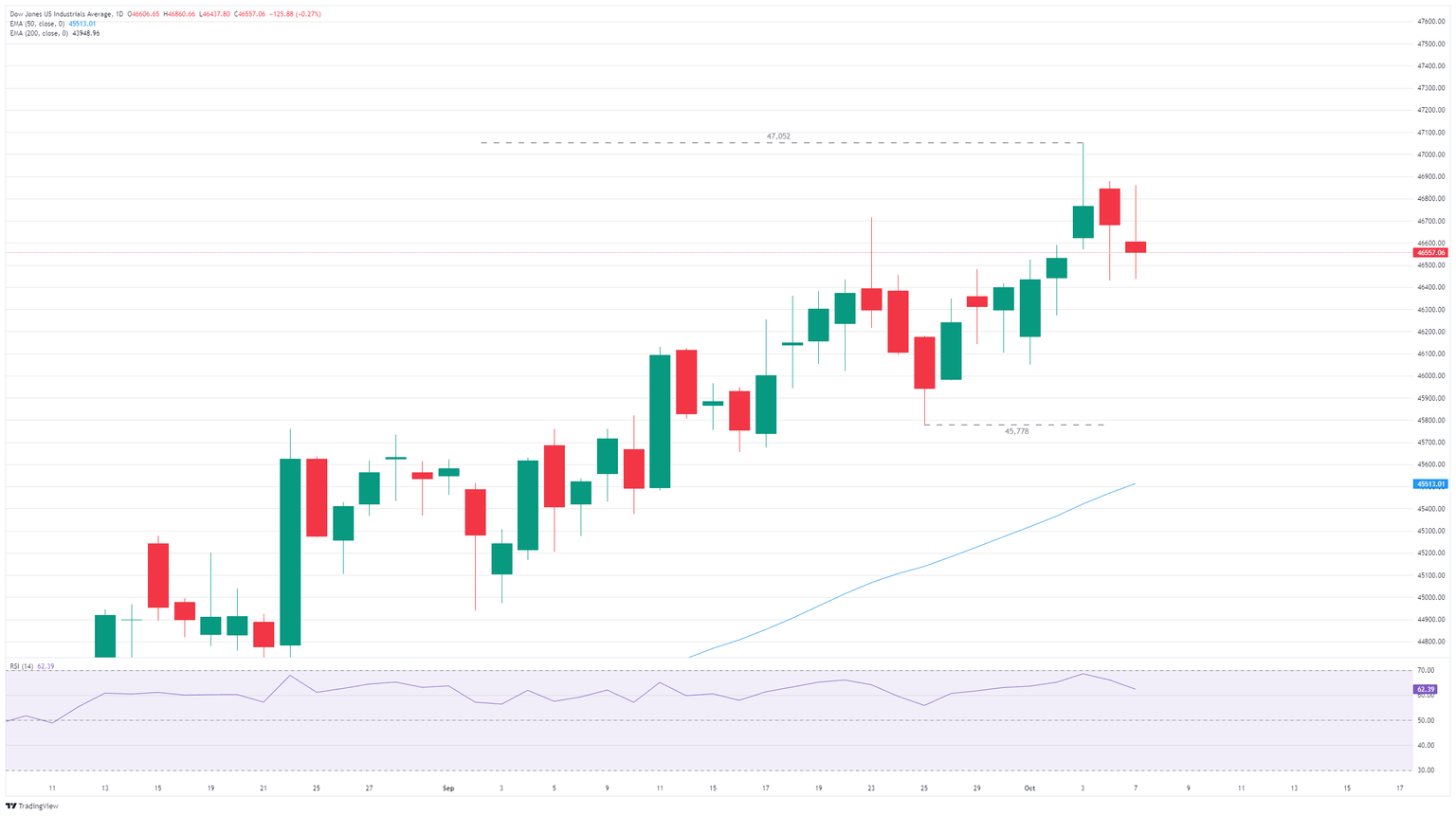
The Dow kicked off Tuesday with a hard drop from overnight highs above 46,800, falling over 420 points top-to-bottom before finding an intraday floor of 46,430. The Dow equity index is now looking for a rebound after finding a technical floor near 46,500.
Oracle gives back some AI hype gains
After a firm surge on expectations of soaring AI-based revenue and joint projects, Oracle (ORCL) led the pack lower, falling after real-world estimates of profits from joint servicing ventures in the AI space fell well short of initial investor reactions. Oracle is generating much thinner profit margins on its cloud business than many expected, and is actually losing money on some of its chip rental schemes with Nvidia (NVDA). Oracle is down nearly 4.5% at the time of publication and has fallen below $280.00 per share.
Government shutdowns may impact some things after all
Investors have been brushing off the US federal government’s shutdown last week, with markets confident that a quick resolution would be found and economic fallout would be minimal. That confidence may prove to have been misplaced, as both sides of the US Congress appear to be no closer to a budget solution than before the lockout began. Traders expected a budget solution to materialize on Monday, or at least some form of progress to have been made.
As the government shutdown rolls on, the Federal Reserve (Fed) will be grappling with a lack of key official datasets as it makes interest rate decisions heading into the tail end of the calendar year. Barring any significant shocks in the data that remains available to the Fed, rate markets have locked in expectations of two follow-up interest rate cuts on October 29 and December 10.
Dow Jones daily chart
Fed FAQs
Monetary policy in the US is shaped by the Federal Reserve (Fed). The Fed has two mandates: to achieve price stability and foster full employment. Its primary tool to achieve these goals is by adjusting interest rates.
When prices are rising too quickly and inflation is above the Fed’s 2% target, it raises interest rates, increasing borrowing costs throughout the economy. This results in a stronger US Dollar (USD) as it makes the US a more attractive place for international investors to park their money.
When inflation falls below 2% or the Unemployment Rate is too high, the Fed may lower interest rates to encourage borrowing, which weighs on the Greenback.
The Federal Reserve (Fed) holds eight policy meetings a year, where the Federal Open Market Committee (FOMC) assesses economic conditions and makes monetary policy decisions.
The FOMC is attended by twelve Fed officials – the seven members of the Board of Governors, the president of the Federal Reserve Bank of New York, and four of the remaining eleven regional Reserve Bank presidents, who serve one-year terms on a rotating basis.
In extreme situations, the Federal Reserve may resort to a policy named Quantitative Easing (QE). QE is the process by which the Fed substantially increases the flow of credit in a stuck financial system.
It is a non-standard policy measure used during crises or when inflation is extremely low. It was the Fed’s weapon of choice during the Great Financial Crisis in 2008. It involves the Fed printing more Dollars and using them to buy high grade bonds from financial institutions. QE usually weakens the US Dollar.
Quantitative tightening (QT) is the reverse process of QE, whereby the Federal Reserve stops buying bonds from financial institutions and does not reinvest the principal from the bonds it holds maturing, to purchase new bonds. It is usually positive for the value of the US Dollar.
