

The retail proprietary trading industry has grown rapidly over the past few years. With hundreds of prop firms offering different challenge models, profit targets, drawdown limits, and pricing structures, choosing the right funded trading program can quickly become confusing.
While most platforms in this space focus on filtering challenges based on user-selected criteria, Propinder, a newly launched comparison platform powered by FXStreet, takes a different approach. A profiling survey guides traders towards suitable challenges based on their preferences, experience, and trading characteristics. In this review, we take a closer look at how Propinder works in practice, with a particular focus on its profiling tool, alongside its more traditional search and comparison features.
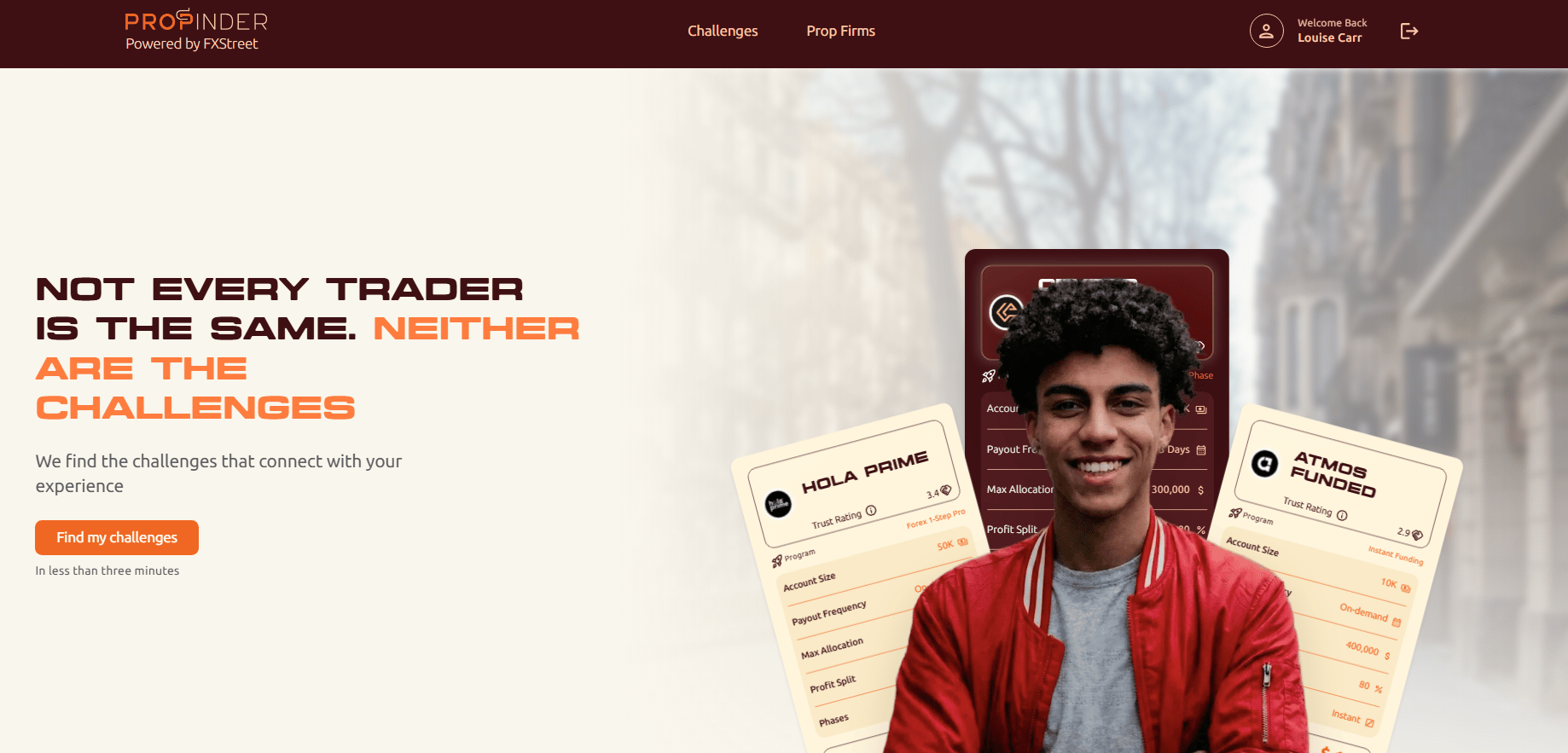
What is Propinder?
Propinder is a prop firm challenge comparison platform that combines traditional filtering tools with a trader profiling system.
At its core, the platform is designed to help traders navigate a fragmented market by bringing multiple challenge programs into one place. What sets it apart is the way it approaches the selection process.
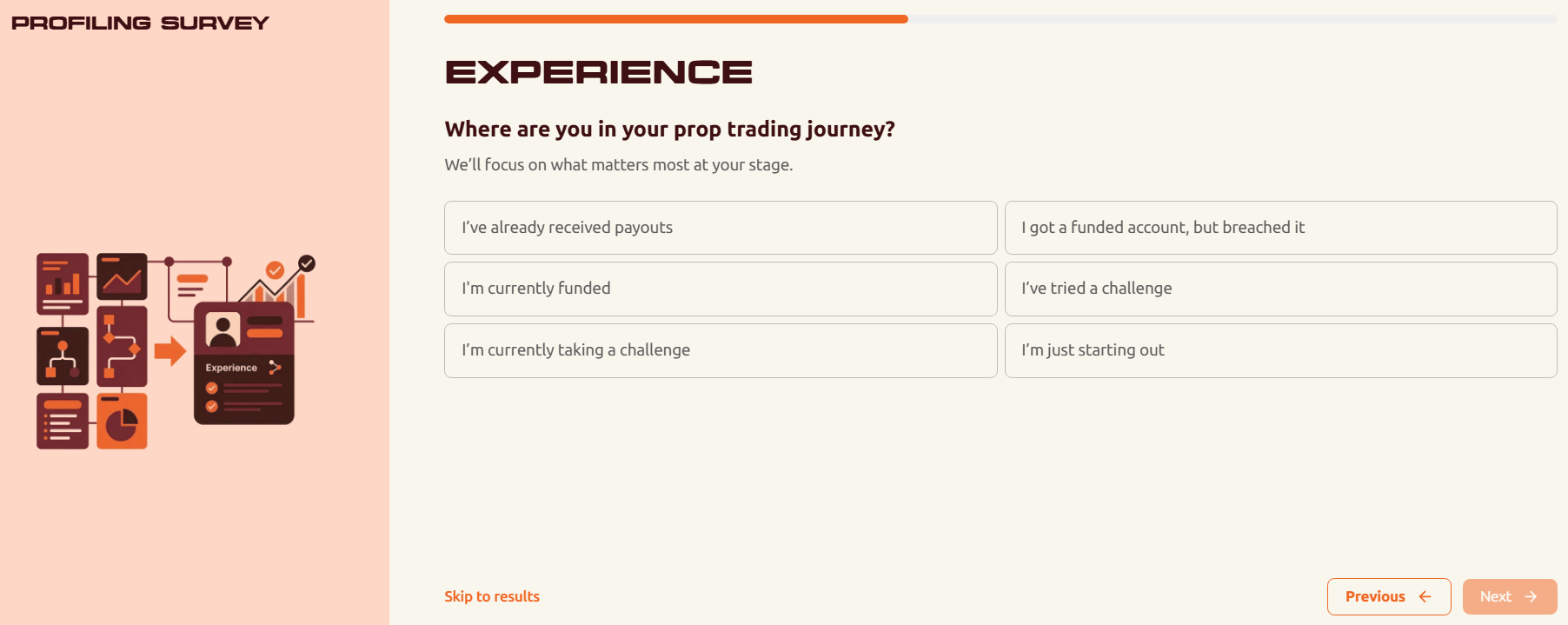
Users are introduced to a profiling survey that asks a series of questions around experience level, risk tolerance, trading preferences, location, and budget. Based on these inputs, the platform looks to connect traders with challenges that may be more suitable for their individual profile, rather than simply listing firms.
The survey is also dynamic in its structure, adapting based on user responses. More experienced traders are prompted with additional questions to better understand their trading approach, while those who have previously failed a challenge may be asked to identify the reason. For funded traders, the survey goes further, exploring trading style, consistency, and risk-to-reward preferences.
This positions Propinder not just as a comparison engine, but also as a tool that guides traders towards more informed decisions.
First impressions
From a usability perspective, the platform is very straightforward and easy to navigate.
The interface is clean and structured around the trader profiling survey, accessible via the homepage link “Find My Challenges.” This shifts the experience away from simply browsing challenges and towards defining what you are looking for as a trader.
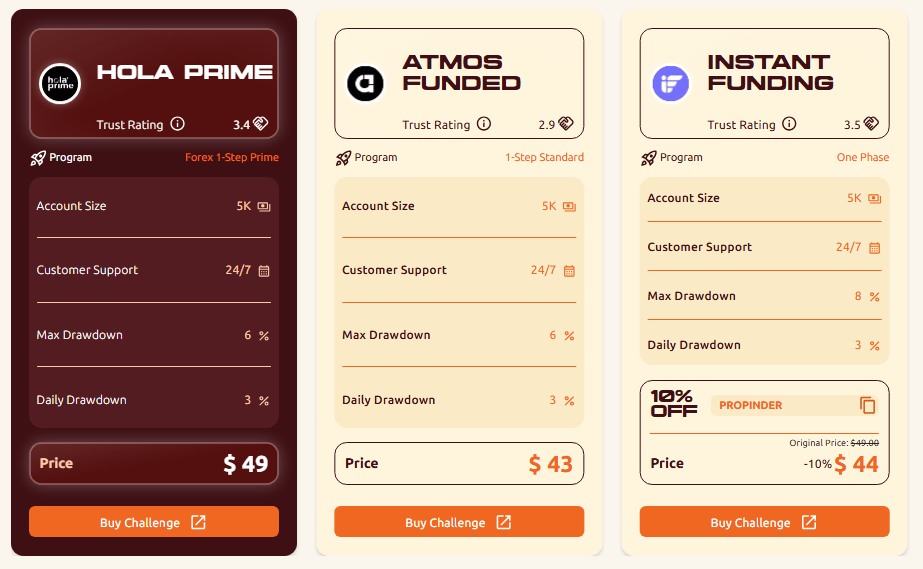
The platform layout is simple, with the option to complete the profiling survey or compare challenges by manually selecting your criteria. For those who opt for the survey, the results are displayed on well-presented challenge cards. Key information, such as pricing, drawdown limits, and trust ratings, is easy to read, allowing for quick comparisons at a glance.
Overall, the platform presents information in an accessible way, particularly for traders who are new to the prop firm space.
Key features
Profiling survey
What makes this type of comparison platform unique is that Propinder includes a profiling tool that recommends prop firm challenges based on a trader’s preferences.
The survey takes only a few minutes to complete and builds a basic trader profile. The intention is to build a basic profile of the trader before presenting any results and to ensure the challenges are available in their location.
Based on these inputs, the platform generates a shortlist of challenges that may be suitable.
This approach differs from traditional comparison tools, which typically rely on users manually selecting filters. By introducing a profiling step first, the platform aims to guide traders towards relevant options before they engage with the broader market, making it very straightforward for new and experienced traders alike.
When traders choose a challenge “Buy Challenge”, they are redirected to the prop firm’s website to complete the purchase.
Challenge comparison
One of the more useful aspects of the platform is the ability to compare challenges across different firms. The profiling tool provides a guided shortlist of three challenges that align with the trader’s profile, while the filtering system allows for more detailed refinement but shows a larger list of challenges for consideration.
Key metrics such as profit targets, drawdown limits, and challenge costs are presented in a standardised format. This makes it easier to identify differences between challenges without having to navigate multiple firm websites.
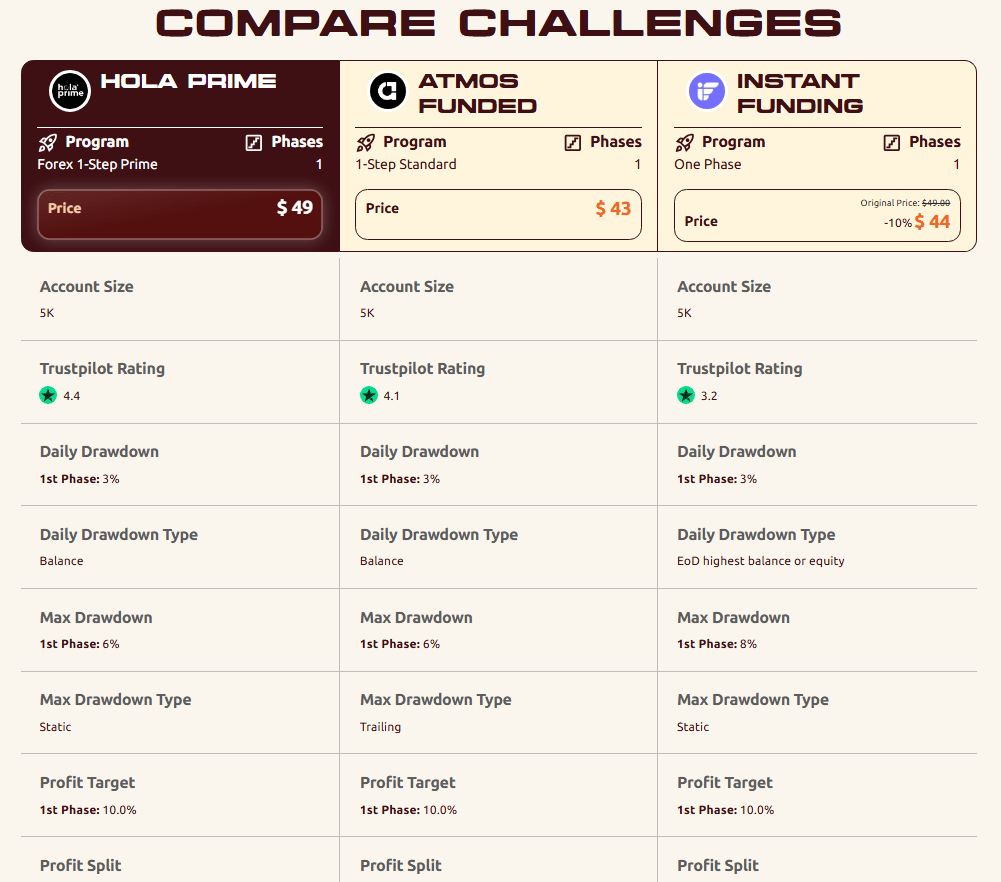
For traders evaluating several options at once, this can significantly reduce the time required to assess different challenge conditions.
Challenge search and filtering
Alongside the profiling tool, Propinder also offers a more traditional challenge search and filtering system.
Users can explore a wider range of challenge plans by applying filters such as account size, maximum drawdown, daily drawdown, challenge phases, and pricing. For example, a trader looking for a $100,000 account with a two-phase evaluation and a maximum drawdown of 10% can narrow down results relatively quickly.
The results based on the selected criteria are presented in a structured table, with key metrics displayed side by side. This makes it easier to scan multiple options and compare core rules without visiting individual prop firm websites.
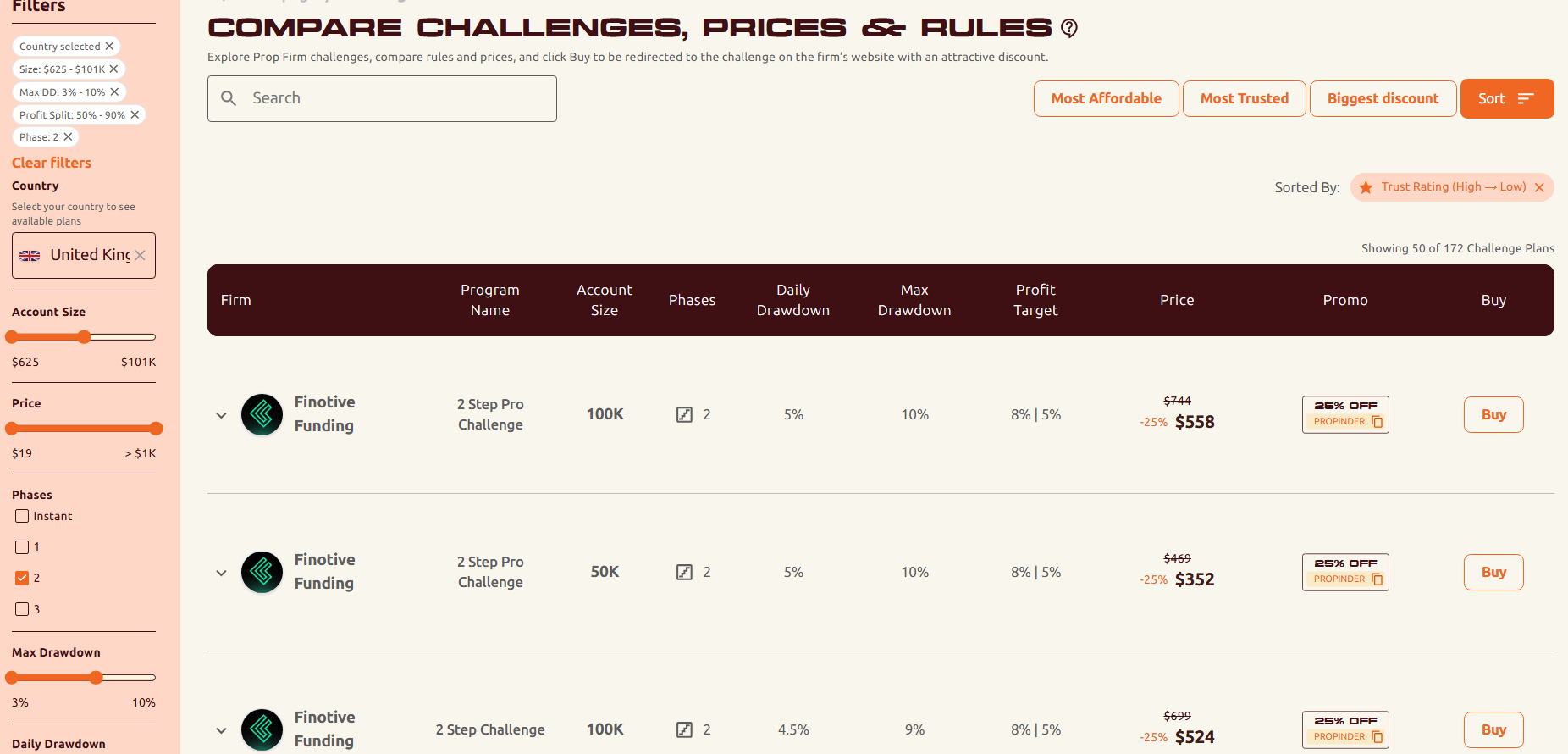
Selecting a challenge expands the view to show additional details, including drawdown types, leverage, payout frequency, and other trading conditions.
If a user chooses to proceed, clicking “Buy Challenge” redirects them to the prop firm’s website, where final selections can be adjusted depending on the provider.
Why is Propinder different?
The key differentiator is the introduction of a profiling-based approach to selecting prop firm challenges, helping traders avoid spending hours manually searching for the right fit.
Most comparison platforms rely entirely on filters, requiring traders to already understand what parameters they are looking for. Propinder instead starts with the trader, aiming to understand their needs before narrowing down suitable options.
The inclusion of questions around experience, risk tolerance, and previous outcomes introduces a more personalised element.
For example, traders who indicate that they have struggled with drawdown limits in the past and may have failed challenges through reaching daily drawdowns may be guided towards challenges with more accommodating risk parameters. Other traders may have failed challenges because of a breach of rules due to news trading. In that case, the system will look for challenges that allow the trader the option to hold positions around the news.
While still developing, this approach represents a shift towards more tailored decision-making in the prop trading space.
Is Propinder trustworthy?
Propinder is powered by FXStreet, a well-established financial media and research provider. This adds credibility to the platform, particularly compared to independent comparison sites with limited transparency.
The platform presents challenge data in a standardised table format, which is easy to view at a glance and helps reduce ambiguity when comparing different firms. However, as with any aggregator, traders should verify challenge details before making a purchase, as rules and pricing can change and these aren’t always immediately reflected in the platform.
When opting to proceed with the purchase, traders are directed to the prop firm’s website, where full terms and conditions can be reviewed before completing the purchase.
The use of referral links is also standard in the industry and does not necessarily affect the platform’s usefulness, provided users remain aware of how listings may be structured.
What are Propinder’s red flags?
While the platform introduces a more guided approach, there are a few areas to be aware of. Following a series of test scenarios using different trading styles, locations, budgets, and levels of trust in emerging prop firms, the following areas stood out for improvement.
The profiling tool, while useful, currently behaves more like a guided filter than a fully adaptive recommendation engine. Across multiple scenarios, results remained relatively consistent even when inputs were adjusted, suggesting room for making the selection process more responsive.
Budget input also tends to act more as a maximum cap than a target range. After running multiple scenarios, we found that in some cases, selecting a higher budget still produced challenges significantly below the stated amount, which may not fully align with user expectations.
In addition, when selected challenges appear, the platform currently does not provide detailed explanations for why the specific challenges are recommended. Greater transparency around the matching logic could help users to understand the results.
Propinder also allows users to filter challenges by categories such as most affordable, biggest discount, and most trusted. However, it is not clearly explained how trust is defined or measured. Given the unregulated and often volatile nature of the prop trading industry, additional clarity around the criteria used to determine trust would further strengthen the platform’s credibility.
Propinder pros and cons
Pros
- Unique profiling tool that connects traders with challenges based on their experience, risk tolerance, and preferences
- Quick and easy to complete, providing a guided starting point without needing to work through complex filters
- Shortlists a small number of relevant challenges, making it easier to focus on quality rather than quantity
- Clear card-style layout that presents key metrics such as pricing, drawdown limits, and rules in a format suited for side-by-side comparison
- Clean, intuitive interface that keeps navigation simple
- Flexible filtering system available for traders who prefer a more manual, detailed approach
Cons
- Profiling results can feel similar across different inputs, with a core group of firms appearing repeatedly
- Budget functions more as a cap than a precise targeting tool
- No clear summary explaining why specific challenges are recommended
- Limited transparency around how the trust rating based on public sentiment and a firm’s track record is calculated and weighted
Final Thoughts
Propinder provides a structured and accessible way to explore prop firm challenges, particularly in a market where the number of available options continues to grow.
Its filtering system is practical and effective, but the standout feature is the profiling survey. It is simple, quick to complete, and offers a more guided way to approach challenge selection. Rather than working through multiple filters and technical parameters, the tool builds a trader profile and narrows the field down to three relevant challenges to review in more detail.
This approach helps cut through the noise, especially for traders who may not yet fully understand how different challenge rules impact their strategy. It also adds value for those with prior prop firm experience. Traders who may have previously failed challenges due to strict drawdown limits or trading restrictions can be guided towards alternatives that offer more flexibility, such as higher loss limits or fewer constraints around news trading.
At its current stage, the profiling feature works best as a guided starting point rather than a fully adaptive decision engine. Some consistency in results across scenarios may also reflect the current limited pool of firms available on the platform. As more providers are added and the matching logic continues to develop, the range and precision of recommendations are likely to improve.
Overall, Propinder is a useful starting point for traders researching prop firm challenges, offering the flexibility of both a guided profiling tool and traditional manual filtering. The results should not replace individual due diligence, but the platform does simplify the process of narrowing down options in a market that is often fragmented and inconsistent.
As its listings expand and the profiling tool continues to develop, Propinder has the potential to evolve from a comparison tool into a more personalised and effective decision-making platform within the growing prop firm space.
