

- Gold registered its largest one-week loss of the year.
- Easing geopolitical tensions caused Gold to lose interest as a safe haven.
- The technical outlook points to a bearish tilt in the near term.
Gold (XAU/USD) fell to its lowest level in over a month below $3,200 after starting the week under heavy bearish pressure. In the absence of high-impact data releases, geopolitical headlines could continue to influence Gold’s valuation in the near term.
Gold drops sharply after US-China trade deal
Gold turned south in the Asian session on Monday as risk flows dominated the action at the weekly opening. Following the first round of official talks between representatives from China and the United States (US) in Switzerland, US Treasury Secretary Scott Bessent said over the weekend that they had “productive and constructive” discussions, while China’s Vice Premier He Lifeng described the talks as “in-depth” and “candid.” In the European morning, Bessent held a press conference to announce that they have agreed to lower reciprocal tariffs by 115% and to pause them for 90 days. Additionally, the India-Pakistan conflict de-escalated after both sides agreed to a ceasefire. Gold extended its slide following these developments and lost more than 2.5% on a daily basis.
After soft inflation data, the US Dollar (USD) lost its strength on Tuesday and helped XAU/USD find a foothold. The data published by the Bureau of Labor Statistics showed that the Consumer Price Index (CPI) and the core CPI rose 0.2% on a monthly basis in April, coming in below the market expectation of a 0.3% increase for both.
Gold came under renewed selling pressure in the second half of the week and touched its lowest level in over a month at $3,120 early Thursday as geopolitical tensions continued to ease. US President Donald Trump said that the US was getting very close to securing a nuclear deal with Iran. Additionally, Russia agreed to hold direct talks with Ukraine in Türkiye. Russia’s top negotiator Vladimir Medinsky said Moscow was aiming for a “long-term and lasting peace.” Later in the day, XAU/USD regained its traction and closed the day in the positive territory as the US data showed that the annual producer inflation, as measured by the change in the Producer Price Index (PPI), dropped to 2.4% in April from 2.7% in March, causing the USD to weaken.
Speaking in Abu Dhabi on Friday, President Trump said that his officials will soon send letters out to countries for trade deals. In the American session, the data from the US showed that the University of Michigan’s Consumer Sentiment Index declined to 50.8 in May’s flash estimate from 52.2. The one-year Consumer Inflation Expectation component of the survey rose to 7.3% from 6.5%. Gold failed to gain traction heading into the weekend and remained in the lower half of its weekly range below $3,200.
Fed stance, geopolitical developments to drive Gold’s price action
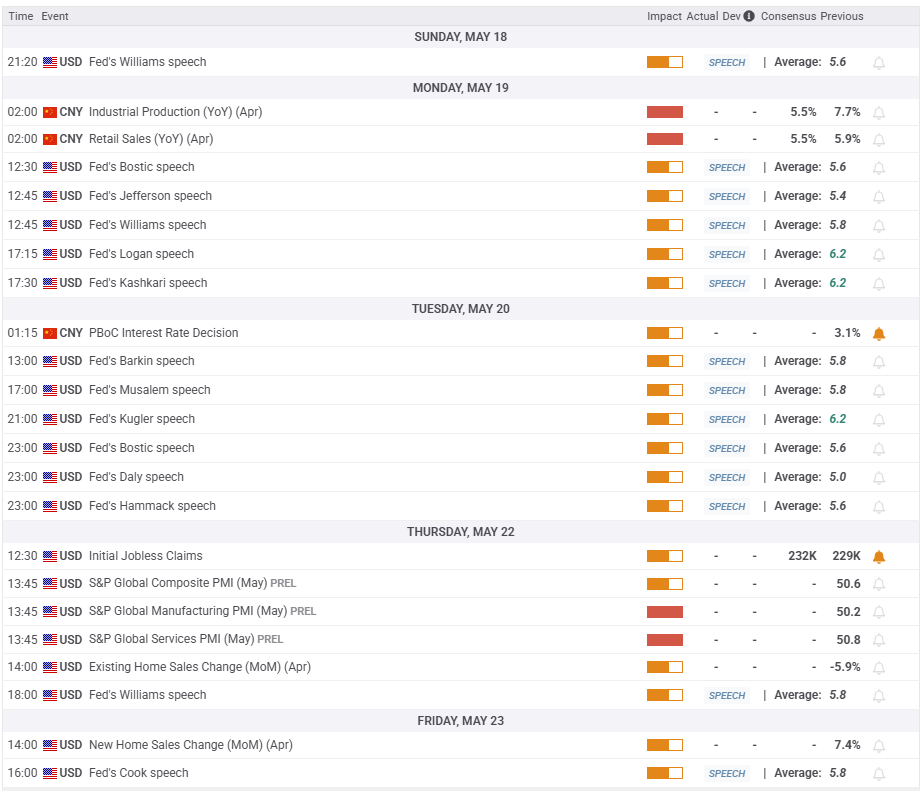
The US economic calendar won’t offer high-tier data releases in the first half of the week. On Thursday, S&P Global will publish the preliminary Manufacturing and Services Purchasing Managers Index (PMI) data for May. In case both prints come in below 50 and reflect a contraction in the private sector’s business activity, the USD could come under selling pressure with the immediate reaction and allow XAU/USD to gain traction.
Several Federal Reserve (Fed) policymakers will be delivering speeches throughout the week. On Friday, Atlanta Fed President Raphael Bostic said that he was expecting the Fed to cut the policy rate just once this year because of uncertainty. In case Fed officials echo the same sentiment, markets could see this as a sign pointing to a hawkish change in June’s revised Summary of Economic Projections. In this scenario, the USD could gather strength and drag XAU/USD lower. According to the CME FedWatch Tool, markets are currently pricing in about an 80% probability of the Fed lowering the policy rate at least twice in 2025.
Needless to say, investors will continue to scrutinize geopolitical developments. In case Russia and Ukraine move closer toward a peace deal, Gold could have a hard time attracting buyers. On the other hand, a deepening crisis in the Middle East, which could potentially cause a deterioration in US-Israel relations, could support the precious metal. President Trump said he did not consult Israel in the decision to recognize Syria’s new government and said that they have to help Palestinians and the starving people in Gaza.
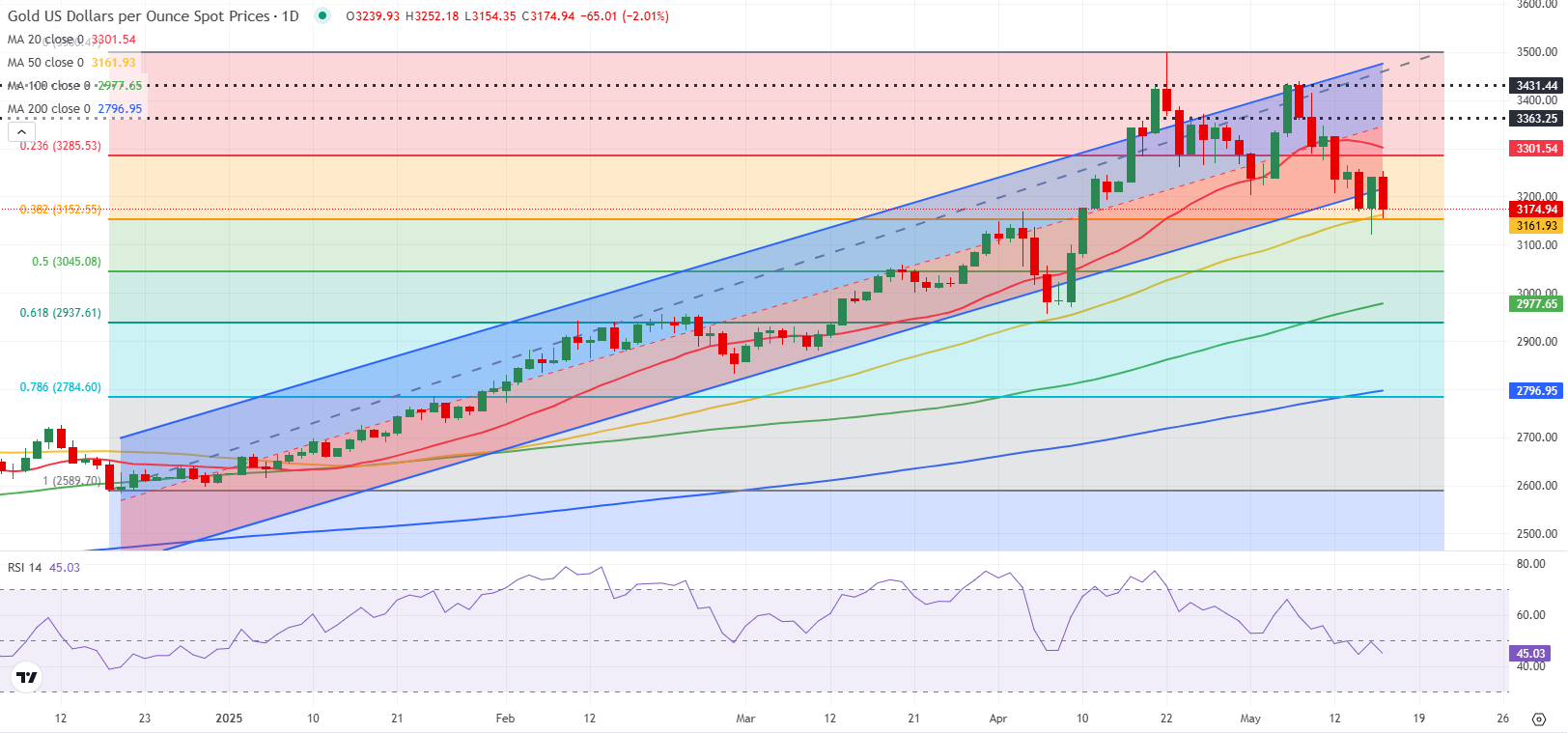
Gold technical analysis
The Relative Strength Index (RSI) indicator on the daily chart dropped below 50, and Gold broke below the lower limit of the ascending regression channel coming from December, pointing to a buildup of bearish momentum.
On the downside, $3,160 (50-day Simple Moving Average (SMA), Fibonacci 38.2% retracement level of the five-month-old uptrend) aligns as immediate support. In case Gold falls below this level and starts using it as resistance, $3,045 (Fibonacci 50% retracement) could be seen as the next support level before $3,000-$2,980 (psychological level, 100-day SMA).
Looking north, the first resistance area could be spotted at $3,290-$3,300 (Fibonacci 23.6% retracement, round level, 20-day SMA) ahead of $3,360 (static level) and $3,430 (static level).
Fed FAQs
Monetary policy in the US is shaped by the Federal Reserve (Fed). The Fed has two mandates: to achieve price stability and foster full employment. Its primary tool to achieve these goals is by adjusting interest rates.
When prices are rising too quickly and inflation is above the Fed’s 2% target, it raises interest rates, increasing borrowing costs throughout the economy. This results in a stronger US Dollar (USD) as it makes the US a more attractive place for international investors to park their money.
When inflation falls below 2% or the Unemployment Rate is too high, the Fed may lower interest rates to encourage borrowing, which weighs on the Greenback.
The Federal Reserve (Fed) holds eight policy meetings a year, where the Federal Open Market Committee (FOMC) assesses economic conditions and makes monetary policy decisions.
The FOMC is attended by twelve Fed officials – the seven members of the Board of Governors, the president of the Federal Reserve Bank of New York, and four of the remaining eleven regional Reserve Bank presidents, who serve one-year terms on a rotating basis.
In extreme situations, the Federal Reserve may resort to a policy named Quantitative Easing (QE). QE is the process by which the Fed substantially increases the flow of credit in a stuck financial system.
It is a non-standard policy measure used during crises or when inflation is extremely low. It was the Fed’s weapon of choice during the Great Financial Crisis in 2008. It involves the Fed printing more Dollars and using them to buy high grade bonds from financial institutions. QE usually weakens the US Dollar.
Quantitative tightening (QT) is the reverse process of QE, whereby the Federal Reserve stops buying bonds from financial institutions and does not reinvest the principal from the bonds it holds maturing, to purchase new bonds. It is usually positive for the value of the US Dollar.
