

- The Dow Jones sank on Wednesday, forced lower by a still-cautious Federal Reserve.
- The Fed’s rate call is locked in as a hold, but market bets of a September rate cut declined sharply.
- Market tensions continue to coil ahead of the August 1 tariff deadline.
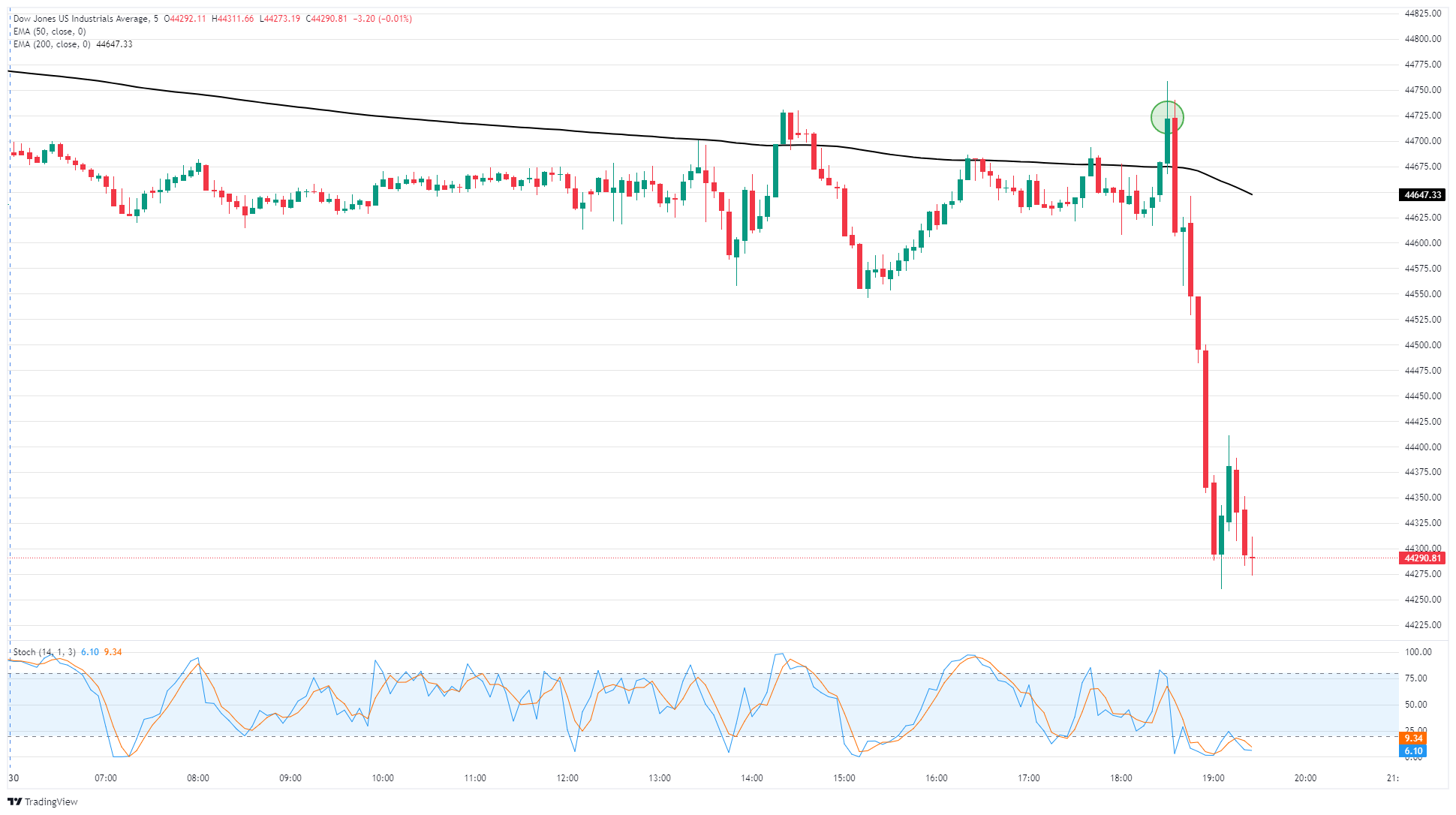
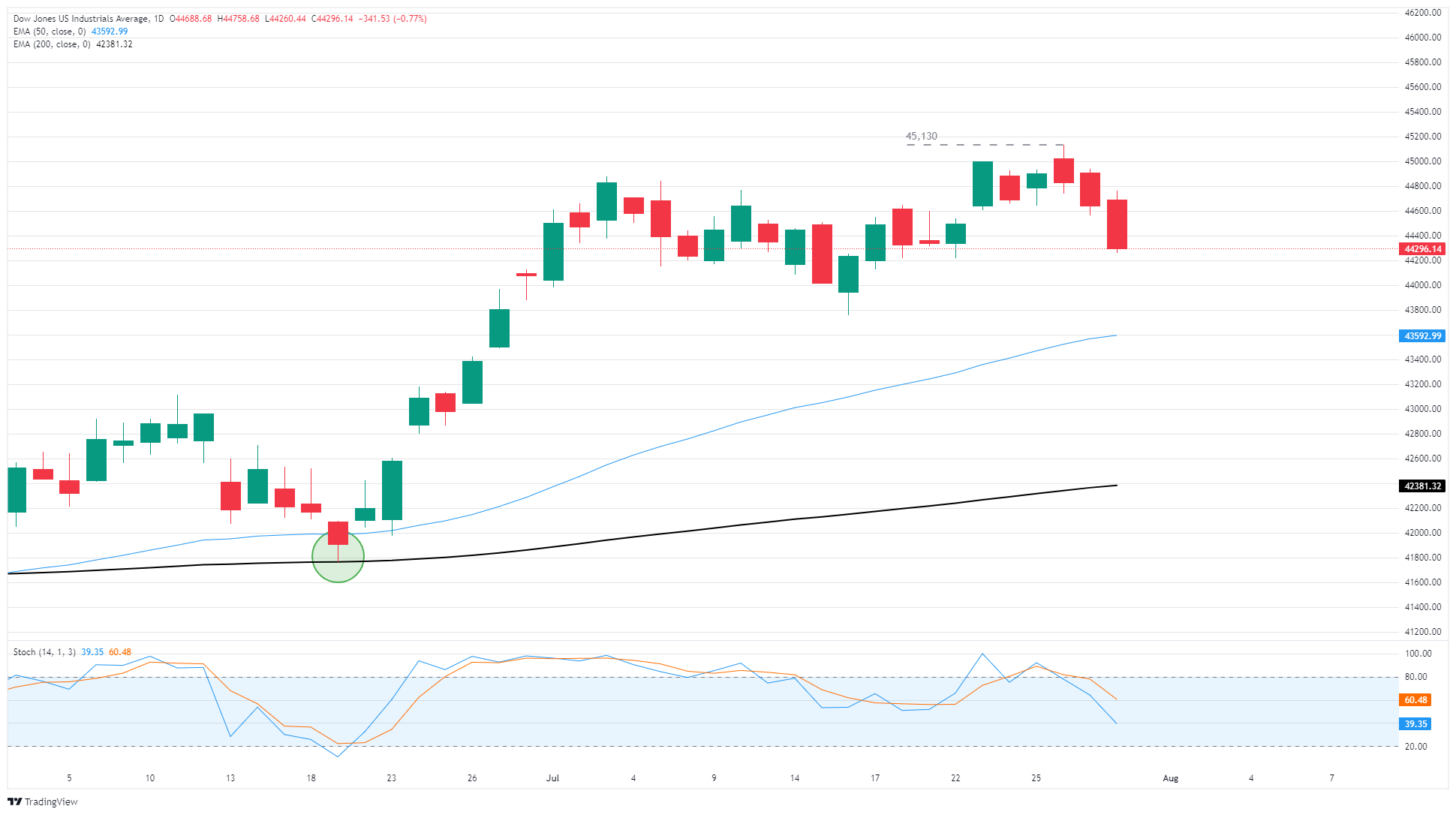
The Dow Jones Industrial Average (DJIA) fell on Wednesday, skidding back below 44,300 after Federal Reserve (Fed) Chair Jerome Powell remains resolute in the Federal Open Market Committee’s (FOMC) decision to continue waiting for better US data and a clearer picture of inflationary impacts from tariffs before making any final decisions on cutting interest rates.
Read more Fed news: Powell say we have made no decisions about September
The Fed held interest rates steady in the 4.25-4.5% range on Wednesday, as many had predicted. What caught traders by surprise was Fed Chair Powell’s insistence on waiting for further data before the Fed will begin to discuss interest rates. US inflation has rebounded in recent months, and despite an overall healthy labor outlook, concerns have grown that the US hiring market may be set to slow sharply in the months ahead.
At the current cut, rate traders are now pricing in less than 50% odds of a rate cut in September, and the new goalpost has been shifted to nearly 90% odds of a quarter-point rate cut in October.

US Gross Domestic Product (GDP) growth came in stronger than expected, with the US economy growing 3.0% on an annualized basis through the second quarter, outpacing the 2.4% forecast. Investors remain fixed on the Fed, however, and equity markets remained largely unchanged post-GDP release.
Key “Magnificent Seven” earnings will be posted on Wednesday after the closing bell. Social media giant and aspiring tech giant Meta Platforms (META), alongside software monolith Microsoft (MSFT), will be posting their latest quarterly earnings reports.
Read more stock news: UPS stock drops back to covid lows as Bank of America cuts price target
What a difference 24 hours makes
On the trade and tariff front, the Trump administration has done an about-face within the span of a single day. On Tuesday, the Trump team proclaimed that the US is nearing a conclusion in trade talks with China and that a wave of successfully negotiated trade deals was earmarked for imminent announcement. On Wednesday, the tone has completely changed: US negotiators abruptly ended trade talks with China, with US President Donald Trump reaffirming his self-imposed deadline of August 1 for the restart of global reciprocal tariffs. Trump also announced a flat 25% tariff on all goods bound for the US from India. Trump also reiterated his intent to start a “penalty” tariff on any country that buys Russian Crude Oil products if Russia doesn’t solve its war in Ukraine within the next ten days.
Dow Jones five-minute chart
Dow Jones daily chart
Fed FAQs
Monetary policy in the US is shaped by the Federal Reserve (Fed). The Fed has two mandates: to achieve price stability and foster full employment. Its primary tool to achieve these goals is by adjusting interest rates.
When prices are rising too quickly and inflation is above the Fed’s 2% target, it raises interest rates, increasing borrowing costs throughout the economy. This results in a stronger US Dollar (USD) as it makes the US a more attractive place for international investors to park their money.
When inflation falls below 2% or the Unemployment Rate is too high, the Fed may lower interest rates to encourage borrowing, which weighs on the Greenback.
The Federal Reserve (Fed) holds eight policy meetings a year, where the Federal Open Market Committee (FOMC) assesses economic conditions and makes monetary policy decisions.
The FOMC is attended by twelve Fed officials – the seven members of the Board of Governors, the president of the Federal Reserve Bank of New York, and four of the remaining eleven regional Reserve Bank presidents, who serve one-year terms on a rotating basis.
In extreme situations, the Federal Reserve may resort to a policy named Quantitative Easing (QE). QE is the process by which the Fed substantially increases the flow of credit in a stuck financial system.
It is a non-standard policy measure used during crises or when inflation is extremely low. It was the Fed’s weapon of choice during the Great Financial Crisis in 2008. It involves the Fed printing more Dollars and using them to buy high grade bonds from financial institutions. QE usually weakens the US Dollar.
Quantitative tightening (QT) is the reverse process of QE, whereby the Federal Reserve stops buying bonds from financial institutions and does not reinvest the principal from the bonds it holds maturing, to purchase new bonds. It is usually positive for the value of the US Dollar.
