

- The US Dollar Index added to the weekly advance, still below 100.00.
- Easing tariff concerns would lend the Dollar a temporary lifeline.
- The Fed could leave its interest rate unchanged next week.
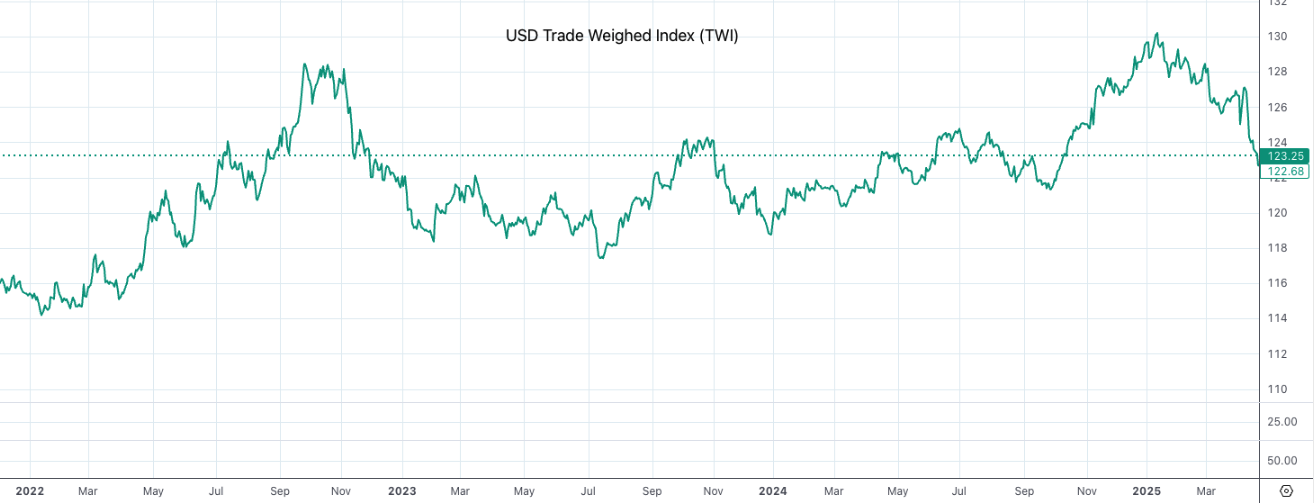
The US Dollar (USD) notched a second straight week of gains, extending its gradual recovery from mid-April lows, though it continued to hover below the psychological 100.00 level on the US Dollar index (DXY), a psychologically important barrier that remains unbroken.
After falling nearly 9% from early March highs and dipping below 98.00 last month, the dollar has been slowly regaining ground. Its latest rebound has partly been supported by easing tensions in the US-China trade narrative, despite a lack of fresh developments in recent days.
This week’s advance also tracked a broader uptick in US Treasury yields, which climbed to multi-day highs across the curve in the latter half of the week, reinforcing the Greenback’s strength even as momentum remained measured.
The tariff narrative loses some impulse… for now
There were no new tariff measures from the White House this week, but the narrative around trade policy took a notable turn. Attention shifted to growing speculation that President Donald Trump may roll back his previously announced 145% tariffs on US imports of Chinese goods—a dramatic pivot from his earlier hardline stance. While the timing and scale of any potential reduction remain unclear, the prospect alone has stirred market interest.
Trump said he is prepared to ease tariffs, attributing the shift to what he described as China’s willingness to strike some fair deal. He added that trade negotiations are “active” and “headed in the right direction.”
The move would mark another instance of the President backing away from more extreme economic policies following adverse market reactions. In recent weeks, Trump has abandoned a blanket tariff threat after a sharp market selloff, softened his tone toward Federal Reserve (Fed) Chair Jerome Powell, and claimed trade wins with Canada and Mexico that were later revealed to be largely symbolic.
As for tariffs, economists warn they remain a double-edged sword. While short-term price spikes may fade, sustained trade barriers risk sparking secondary inflation pressures, curbing consumer demand, slowing growth, and even reviving deflationary risks. Should economic strain deepen, the Federal Reserve could be forced to reconsider its current wait-and-see approach.
Fed holds steady as Powell warns of stagflation risks
The Federal Reserve kept its benchmark interest rate unchanged at 4.25%–4.50% during its March 19 meeting, maintaining a cautious stance amid heightened market volatility and growing concern over stagflation. Policymakers downgraded their 2025 GDP growth forecast to 1.7% from 2.1% and nudged their inflation outlook higher to 2.7%, signaling a more fragile economic outlook.
Fed Chair Jerome Powell adopted a measured tone at the post-meeting press conference, noting there was “no immediate need” for further rate cuts. Still, he acknowledged that recently imposed tariffs were “larger than expected” and warned that rising inflation alongside higher unemployment could threaten the Fed’s dual mandate.
In a separate appearance at the Economic Club of Chicago, Powell pointed to signs of early economic softening, including sluggish consumer spending, weakening business sentiment, and a rush of pre-tariff imports—all of which could weigh on growth in the months ahead. He reaffirmed that monetary policy would remain on hold as the central bank assesses the impact of recent shocks.
Ahead of the Fed’s pre-meeting blackout period, officials signalled a cautious posture, emphasising the need to evaluate the potential fallout from the Trump administration’s sweeping new tariffs.
Inflation fears grow as Dollar slides on stagflation concerns
The Greenback managed to temporarily shrug off some fears of stagflation in the last few days, where weak growth meets persistent inflation, lending fresh oxygen to investor sentiment. A mix of tariff-induced drag, slowing domestic momentum, and softening confidence has been fueling the Greenback’s decline lately.
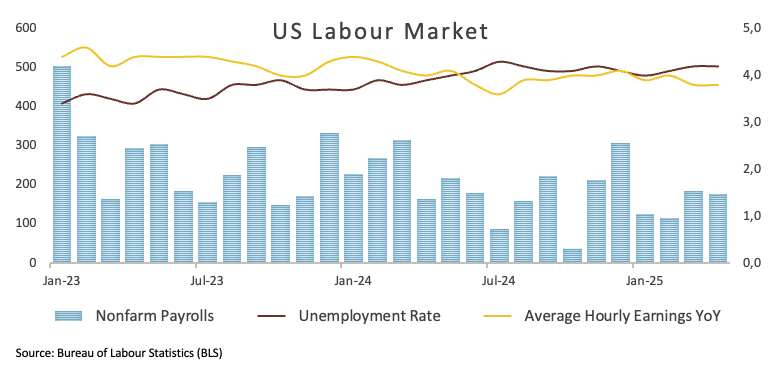
Inflation remains elevated above the Federal Reserve’s 2% target, as underscored by recent CPI and PCE readings. Complicating the Fed’s outlook is a labor market that remains unexpectedly strong, defying calls for a sharper slowdown and limiting the case for immediate rate cuts.
Adding to the pressure, consumer inflation expectations have ticked higher. The New York Fed’s latest survey shows Americans expect prices to rise 3.6% over the next year, up from 3.1% in February—the highest level since October 2023. Longer-term expectations, however, remain stable, suggesting confidence in the Fed’s longer-run credibility.
However, the labor market remained relatively firm in April, as the US economy added more jobs than previously estimated (+177K), while the jobless rate held steady at 4.2%. The caveat, however, is that these figures do not yet reflect the impact of tariffs imposed after “Liberation Day”, a development market participants will likely assess more fully in upcoming data releases.
For now, a volatile mix of sticky inflation, trade-related uncertainty, and weakening fundamentals is expected to keep the US Dollar on the back foot, with market turbulence likely to persist in the near term.
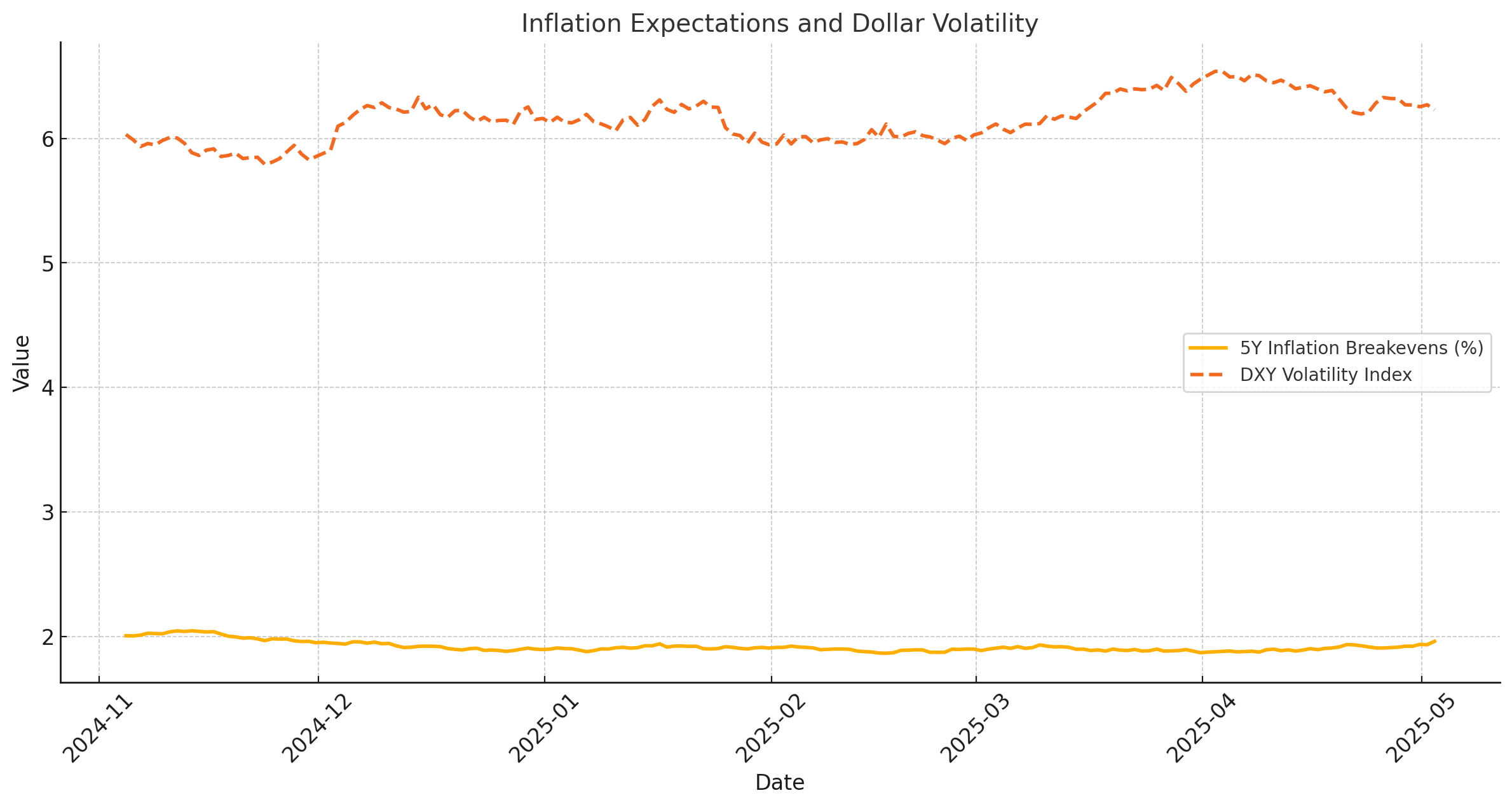
The chart illustrates how inflation expectations are edging higher while dollar volatility remains elevated—underscoring market jitters around stagflation risks and Fed policy uncertainty.
What’s next for the Dollar?
Next week’s spotlight will be firmly on the Federal Reserve, with the FOMC set to meet amid broad expectations that policymakers will keep rates unchanged. April’s solid Nonfarm Payrolls report has reinforced the Fed’s wait-and-see stance, reducing the likelihood of any immediate policy shifts.
Beyond the Fed, markets will stay alert to any movement on the trade front, particularly signs of progress or further escalation in the US-China tariff dispute.
DXY holds bearish bias below key moving averages
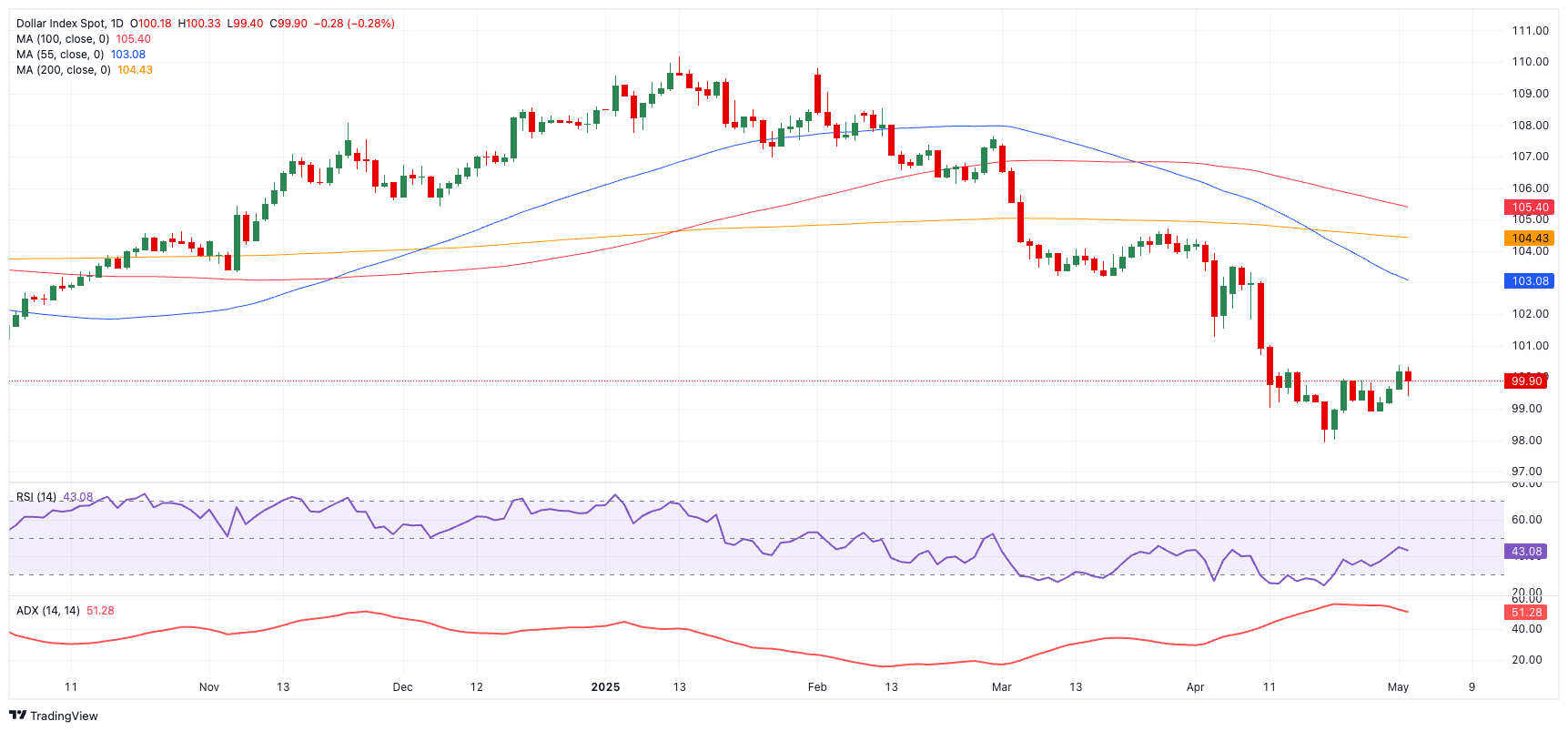
The US Dollar Index (DXY) remains under firm downward pressure, trading beneath both its 200-day (104.41) and 200-week (102.71) simple moving averages (SMAs), a clear sign that the broader bearish trend remains intact.
Support levels to watch include 97.92, the 2025 floor set on April 21, and the March 30, 2022 pivot at 97.68. On the upside, any rebound could face resistance at the key 100.00 psychological level, followed by the temporary 55-day SMA at 103.22 and the March 26 peak at 104.68.
Momentum indicators further confirm the bearish outlook. The Relative Strength Index (RSI) has eased to 42, while the Average Directional Index (ADX) has climbed above 52, pointing to a strengthening downtrend.
US Dollar FAQs
The US Dollar (USD) is the official currency of the United States of America, and the ‘de facto’ currency of a significant number of other countries where it is found in circulation alongside local notes. It is the most heavily traded currency in the world, accounting for over 88% of all global foreign exchange turnover, or an average of $6.6 trillion in transactions per day, according to data from 2022.
Following the second world war, the USD took over from the British Pound as the world’s reserve currency. For most of its history, the US Dollar was backed by Gold, until the Bretton Woods Agreement in 1971 when the Gold Standard went away.
The most important single factor impacting on the value of the US Dollar is monetary policy, which is shaped by the Federal Reserve (Fed). The Fed has two mandates: to achieve price stability (control inflation) and foster full employment. Its primary tool to achieve these two goals is by adjusting interest rates.
When prices are rising too quickly and inflation is above the Fed’s 2% target, the Fed will raise rates, which helps the USD value. When inflation falls below 2% or the Unemployment Rate is too high, the Fed may lower interest rates, which weighs on the Greenback.
In extreme situations, the Federal Reserve can also print more Dollars and enact quantitative easing (QE). QE is the process by which the Fed substantially increases the flow of credit in a stuck financial system.
It is a non-standard policy measure used when credit has dried up because banks will not lend to each other (out of the fear of counterparty default). It is a last resort when simply lowering interest rates is unlikely to achieve the necessary result. It was the Fed’s weapon of choice to combat the credit crunch that occurred during the Great Financial Crisis in 2008. It involves the Fed printing more Dollars and using them to buy US government bonds predominantly from financial institutions. QE usually leads to a weaker US Dollar.
Quantitative tightening (QT) is the reverse process whereby the Federal Reserve stops buying bonds from financial institutions and does not reinvest the principal from the bonds it holds maturing in new purchases. It is usually positive for the US Dollar.
