

Let’s be honest: in consumer lending, “friction” is usually treated like a dirty word. We all want a seamless, fast, and completely frictionless experience for borrowers.
But as we navigate the complexities of 2026, lenders are facing a paradox. On one hand, there is immense pressure to drive growth. On the other hand, delinquencies for auto and credit cards are hovering near Great Recession highs, and traditional safety nets—like the classic credit score—are changing shape.
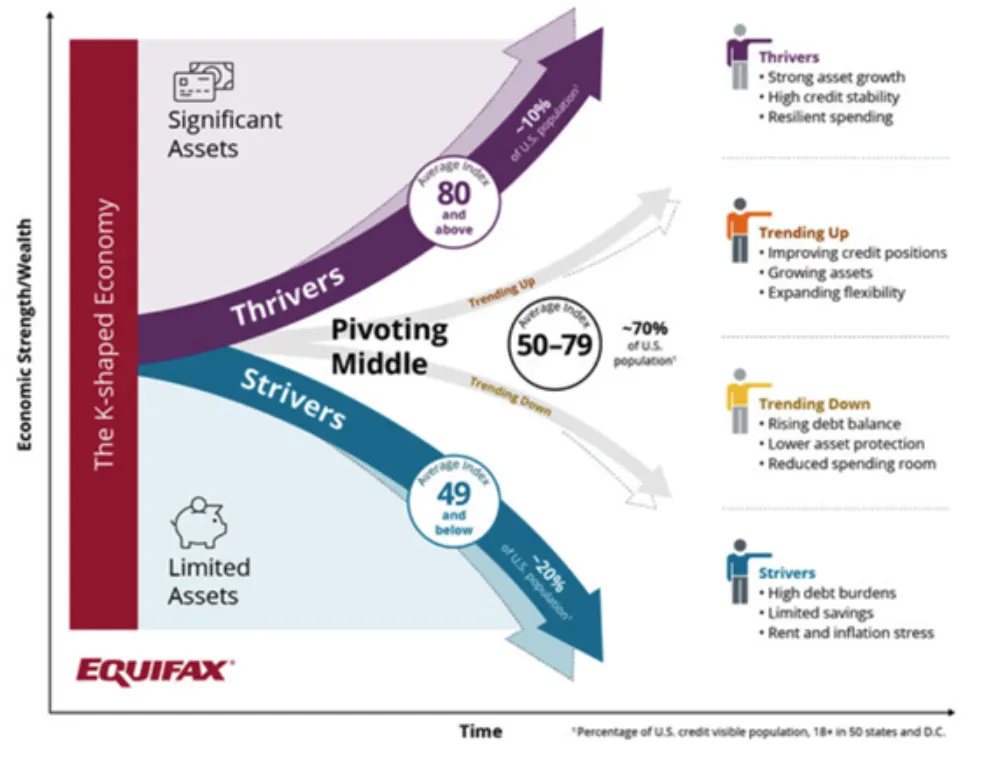
Add in a K-shaped economy where the economic realities of consumers are sharply dividing, and suddenly, the old playbook doesn’t quite work.
So, how do you grow safely when the middle class is shrinking and the risk landscape is shifting?
At our recent Equifax webinar, “Decoding Borrower Capacity in the 2026 K-Shaped Economy,” my colleagues Sharla Godbehere (SVP, Financial Services), Jim Sondermann (Analytical Consulting, Consumer Lending), and I dove deep into the data to find out. Below is what the data tells us about where the real opportunities lie this year.
🗳️ What Lenders Are Saying: The High-Income, No-File Paradox
During the live event, we polled our audience of risk, underwriting, and lending leaders to see where they struggle most. We asked:
“What is your biggest hurdle when evaluating a borrower with a thin-file/no-file credit score who claims a high stable income?”
The results were eye-opening and highlight a massive gap in traditional underwriting:
Does this sound familiar? Lenders are sitting on a goldmine of potential high-income customers but feel handcuffed by a lack of trustworthy, automated alternative data.
1. The Shrinking Middle and the Rise of “Strivers”
Permission granted by Equifax
According to the latest Equifax Market Pulse data, our economy is actively splitting. Over the last two years:
If you are only writing loans for the “Thrivers,” you are fighting over a tiny fraction of the market. To truly grow, lenders have to learn how to safely say “yes” to the “Strivers” and the migrating middle.
2. Debunking the “No-Score” Myth
For years, many lenders had a simple rule for thin-file or unscoreable applicants: No score, no loan. The assumption was that unscoreable applicants perform like deep subprime risks.
The data tells a completely different story. Our recent study of over 9 million card originations revealed that the unscoreable/missing-file population actually performs remarkably close to the 600–639 credit band—making them look much more like near-prime borrowers than subprime risks.
(Source: Equifax Data Study, 2022-2024)
By auto-declining this segment, lenders are leaving massive, highly viable portfolio growth on the table.
3. Slicing through the Noise with Alternative Data
If two applicants both walk into your institution with a 699 credit score, are they the same risk? Absolutely not.
When we overlay income, employment tenure, and job stability onto traditional credit files, the risk splits dramatically:
-
The Power of Income: Across every single credit tier, higher income directly correlates to lower delinquency. But it’s about more than just a self-reported income number. If you leverage actual payroll data, a borrower with a 550 score and a strong, verified income can actually perform like a 600-score borrower.
-
Active vs. Inactive Job Transitions: This is one of the most powerful risk-segmentation tools unique to automated payroll databases. When an applicant has an “inactive” record (indicating a job transition or gap in employment in the last year), their delinquency risk is up to ~40% higher.
Integrating more data points allows you to build a highly intelligent, layered “swap-in” strategy—giving you more confidence to approve borrowers you might have ignored in the past.
4. Smart Friction: The Fraud Waterfall
I mentioned earlier that friction is often seen as a dirty word. But when it comes to modern fraud—like credit washing, loan stacking, and synthetic identities—friction is actually your friend if used early and strategically.
The trick is introducing smart friction early in the fraud waterfall. This strategic method of slightly slowing down the lending process at the very beginning allows you the opportunity to catch fraudsters before you waste time, operational expense, or loan capital.
Traditional data often only tells half the story.
Lenders don’t need help finding ways to decline people—they’ve already got tight credit boxes for that. What they need is the right data to figure out how to safely approve more.
In a K-shaped economy, relying solely on traditional credit scores may mean you are missing out on opportunities for growth and serving more customers. By pulling in alternative capacity data, you can find those resilient borrowers hidden in the near-prime and un-scoreable bands.
Curious how alternative data can safely expand your lending portfolio? Grab a coffee and watch our full webinar for a deep dive into ways you can help decode the 2026 borrower.
Prefer a 1-on-1 chat tailored to your specific goals? Let’s connect and schedule some time to talk.
