

Gold (XAU/USD) meets with a fresh supply during the Asian session on Thursday and weakens further below the $4,200 mark, sliding back closer to the weekly low in the last hour. The US Dollar (USD) attempts a modest recovery from its lowest level since late October, touched on Wednesday, and turns out to be a key factor undermining the commodity. Moreover, a generally positive tone around the equity markets contributes to driving flows away from the safe-haven precious metal.
The upside for the USD, however, seems limited on the back of the growing acceptance that the US Federal Reserve (Fed) will lower borrowing costs again next week. This, in turn, could lend some support to the non-yielding Gold. Furthermore, persistent geopolitical uncertainties stemming from the protracted Russia-Ukraine war should help limit the downside for the XAU/USD pair. Traders might also opt to wait for the crucial US inflation data on Friday before placing fresh directional bets.
Daily Digest Market Movers: Gold is pressured by receding safe-haven demand and rebounding USD
- Automatic Data Processing reported on Wednesday that private payrolls unexpectedly fell by 32K in November, compared to the 47K increase (revised from 42K) in the previous month and below expectations of 5K job additions. This suggested that the slowdown in the US labor market intensified last month.
- Furthermore, the recent US macro data pointed to a gradual cooling of the economy, which, along with comments from several Federal Reserve officials, lifted bets for a 25-basis-point rate cut at the upcoming FOMC meeting next week. This continues to act as a tailwind for the non-yielding Gold on Thursday.
- Meanwhile, the prospects for lower US interest rates remain supportive of the underlying bullish sentiment around the equity markets. Apart from this, a modest US Dollar uptick turns out to be another factor that is seen acting as a headwind for the safe-haven commodity during the Asian session on Thursday.
- However, dovish Fed expectations might keep a lid on any meaningful USD recovery. Investors might also opt to wait for the release of the US Personal Consumption Expenditure (PCE) Price Index on Friday for more cues about the Fed’s rate-cut path and before placing directional bets around the XAU/USD pair.
- In the meantime, traders will take cues from Thursday’s US economic docket – featuring Challenger Job Cuts and the usual Weekly Initial Jobless Claims – for some impetus later during the North American session. Apart from this, the broader risk sentiment could produce short-term trading opportunities.
- US special envoy Steve Witkoff will meet Ukraine’s head of the National Security Council, Rustem Umerov, for talks on Thursday after failing to reach a compromise on a possible peace deal with Russian President Vladimir Putin. This keeps geopolitical risks in play and could further support the safe-haven commodity.
Gold could extend the slide once the $4,164-4,163 support, or the weekly low is broken
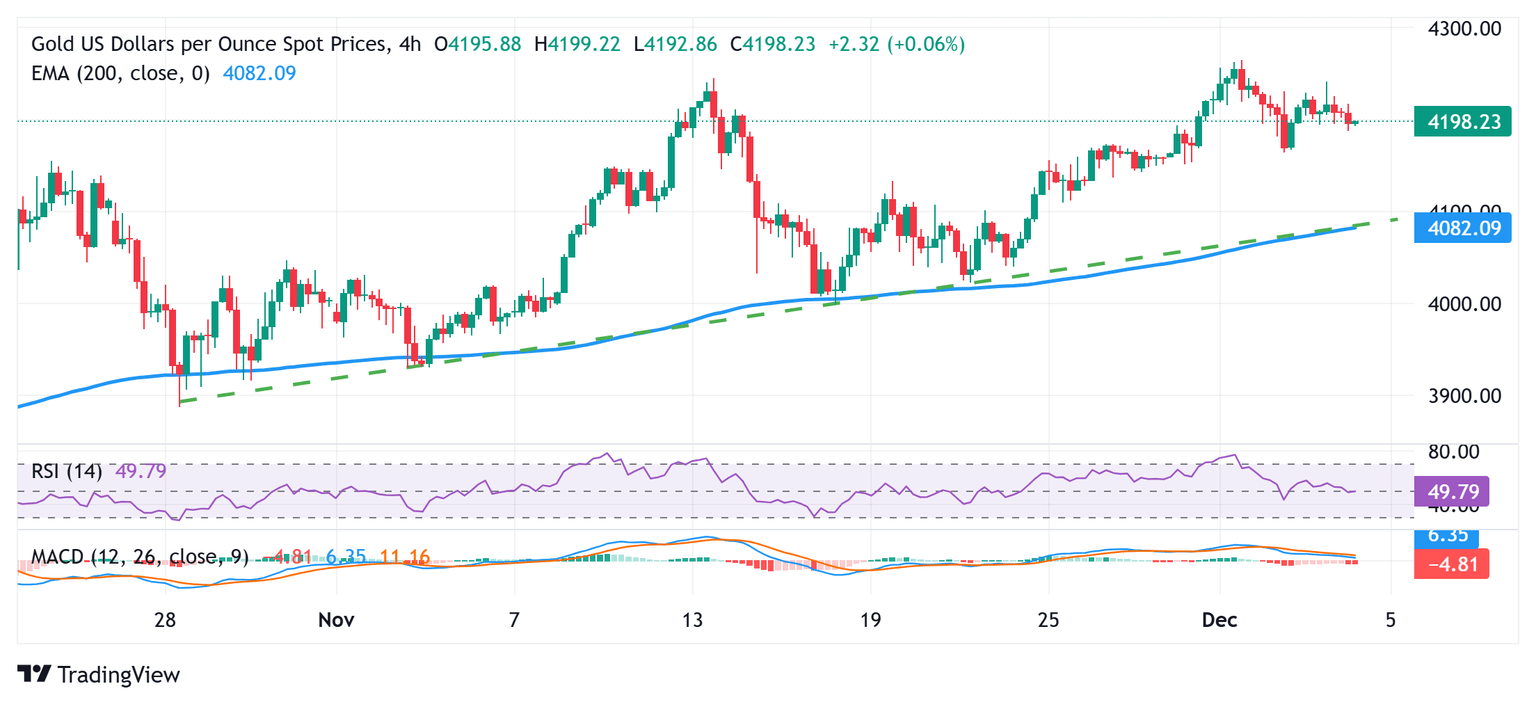
The recent repeated failures to find acceptance above the $4,245-4,250 barrier and the subsequent slide favor the XAU/USD bears. However, mixed technical oscillators on hourly/daily charts suggest that any further slide is more likely to find decent support near the weekly swing low, around the $4,164-4,163 area, touched on Tuesday.
Some follow-through selling, however, could drag the Gold price to the $4,100 mark en route to the $4,085 confluence. The latter comprises the 200-period Exponential Moving Average (EMA) on the 4-hour chart and an ascending trend-line extending from late October, which should act as a strong near-term base.
On the flip side, the $4,245-4,250 zone might continue to act as an immediate strong barrier ahead of the $4,277-4,278 region, above which the Gold price could aim to reclaim the $4,300 round figure. A sustained strength beyond the latter will be seen as a key trigger for the XAU/USD bulls and pave the way for additional near-term gains.
US Dollar Price Today
The table below shows the percentage change of US Dollar (USD) against listed major currencies today. US Dollar was the strongest against the Swiss Franc.
| USD | EUR | GBP | JPY | CAD | AUD | NZD | CHF | |
|---|---|---|---|---|---|---|---|---|
| USD | 0.06% | 0.08% | 0.00% | 0.07% | -0.14% | 0.05% | 0.14% | |
| EUR | -0.06% | 0.02% | -0.05% | 0.00% | -0.21% | -0.01% | 0.08% | |
| GBP | -0.08% | -0.02% | -0.06% | -0.01% | -0.23% | -0.03% | 0.06% | |
| JPY | 0.00% | 0.05% | 0.06% | 0.05% | -0.15% | 0.01% | 0.13% | |
| CAD | -0.07% | -0.00% | 0.01% | -0.05% | -0.20% | -0.02% | 0.07% | |
| AUD | 0.14% | 0.21% | 0.23% | 0.15% | 0.20% | 0.19% | 0.28% | |
| NZD | -0.05% | 0.00% | 0.03% | -0.01% | 0.02% | -0.19% | 0.09% | |
| CHF | -0.14% | -0.08% | -0.06% | -0.13% | -0.07% | -0.28% | -0.09% |
The heat map shows percentage changes of major currencies against each other. The base currency is picked from the left column, while the quote currency is picked from the top row. For example, if you pick the US Dollar from the left column and move along the horizontal line to the Japanese Yen, the percentage change displayed in the box will represent USD (base)/JPY (quote).
