

The Japanese Yen (JPY) attracts fresh sellers heading into the European session on Friday and remains within striking distance of the lowest level since February, touched against a bullish US Dollar (USD) the previous day. Stronger consumer inflation figures from Tokyo – Japan’s capital city – revived bets for an imminent interest rate hike by the Bank of Japan (BoJ). The initial market reaction, however, turns out to be short-lived as traders seem convinced that the BoJ could resist further policy tightening amid expectations that Japan’s Prime Minister Sanae Takaichi will pursue aggressive fiscal spending plans. This, in turn, keeps a lid on the JPY’s modest intraday uptick.
Apart from this, the latest optimism led by a de-escalation of US-China trade tensions is seen as another factor undermining the JPY’s safe-haven status. The US Dollar (USD), on the other hand, stands firm near its highest level since early August in the wake of the US Federal Reserve’s (Fed) hawkish tilt, which forced investors to pare their bets for another interest rate cut in December. This, in turn, offers additional support to the USD/JPY pair and backs the case for an extension of the recent well-established uptrend witnessed over the past two weeks or so. Traders now look to speeches from influential FOMC members for short-term opportunities heading into the weekend.
Japanese Yen seems vulnerable as bears shrug off stronger Tokyo CPI amid BoJ uncertainty
- The internal affairs ministry reported this Friday that the Consumer Price Index in Tokyo – Japan’s capital city – rose to the 2.8% YoY rate in October from 2.5% in the previous month. Adding to this, the core gauge, which excludes volatile fresh food prices, climbed from the 2.5% YoY rate in September to 2.8% during the reported month.
- Furthermore, the core CPI that excludes both fresh food and energy prices, which has stayed above the Bank of Japan’s 2% target for three-and-a-half-years, rose to 2.8% from 2.5%. The data backs the case for the BoJ to keep raising interest rates gradually, which, in turn, provides a modest boost to the Japanese Yen during the Asian session.
- The BoJ held rates steady at the end of a two-day meeting on Thursday despite two dissenting votes, with board members Naoki Tamura and Hajime Takata pushing for a hike to 0.75%. Moreover, BoJ Governor Kazuo Ueda said during the post-meeting press conference that there are no preset ideas about the timing of the next rate hike.
- Moreover, Japan’s new Prime Minister Sanae Takaichi’s pro-stimulus stance could allow the BoJ to delay raising interest rates further, which, in turn, could act as a headwind for the JPY. The US Dollar, on the other hand, draws some support from the Federal Reserve’s hawkish tilt and should contribute to limiting losses for the USD/JPY pair.
- The US central bank lowered its benchmark overnight borrowing rate for the second time this year, to a range of 3.75%-4%. However, Fed Chair Jerome Powell said that a further reduction in the policy rate at the December meeting is not a foregone conclusion. Traders were quick to react and trimmed their bets for more easing this year, which, in turn, pushed the USD to its highest level since early August on Thursday and the USD/JPY pair to an eight-month peak.
- The US government shutdown has now entered its fifth week amid a deadlock in Congress on the Republican-backed funding bill, fueling economic concerns. This is holding back the USD bulls from placing aggressive bets. Traders now look to speeches from influential FOMC members for cues about the future rate-cut path and a fresh impetus.
USD/JPY seems poised to climb further beyond the 155.00 psychological mark
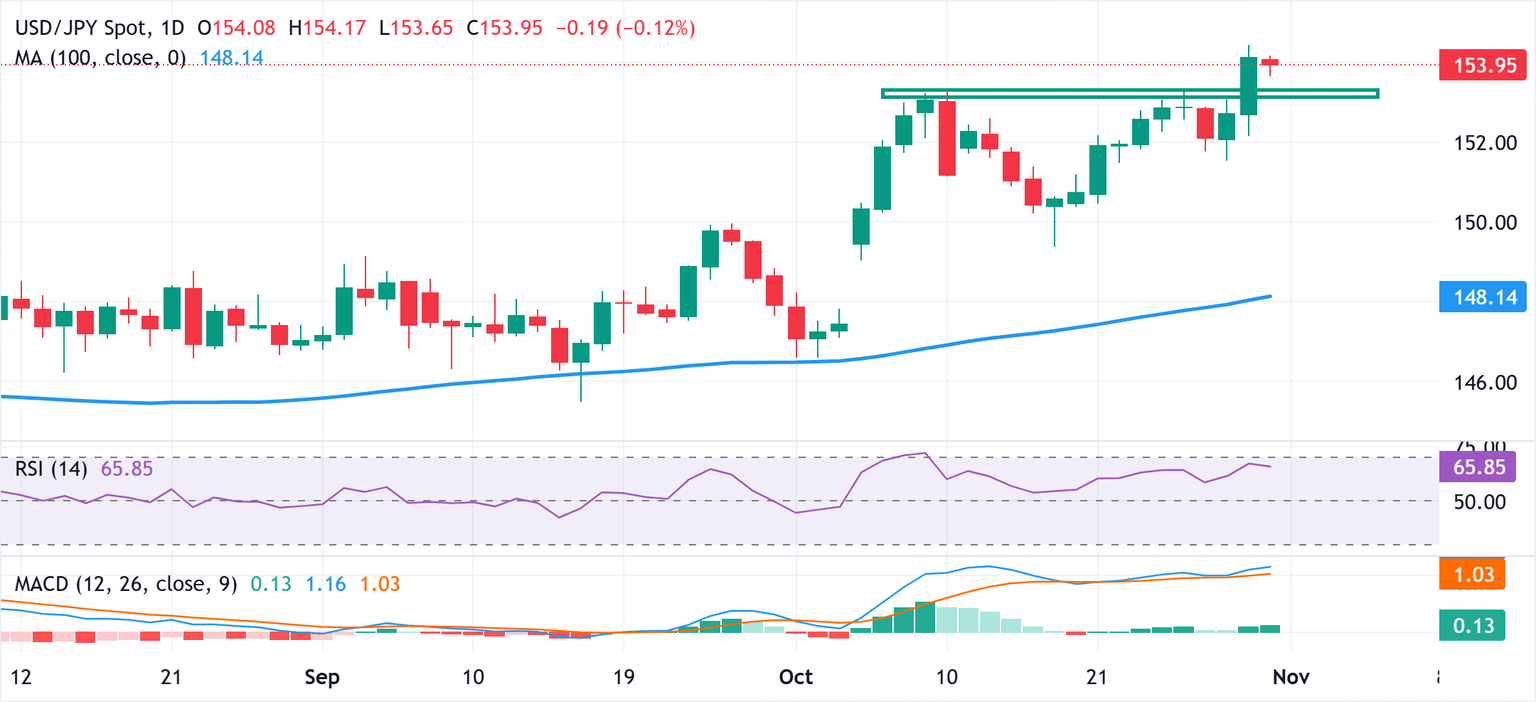
From a technical perspective, the overnight breakout through the 153.25-153.30 region, or the previous monthly swing high, and a subsequent strength beyond the 154.00 mark, was seen as a key trigger for the USD/JPY bulls. Moreover, oscillators on the daily chart are holding comfortably in positive territory and are still away from being in the overbought zone. This, in turn, backs the case for the emergence of some dip-buying at lower levels. Nevertheless, spot prices seem poised to climb further beyond mid-154.00s, towards the 154.75-154.80 region en route to the 155.00 psychological mark.
On the flip side, weakness below the 154.00 mark is likely to find decent support and remain limited near the 153.30-153.25 resistance-turned-support. This is followed by the 153.00 round figure, which, if broken decisively, might expose the overnight swing low, around the 152.15 region. Some follow-through selling below the 152.00 mark would negate any near-term positive bias and pave the way for deeper losses towards the 151.55-151.50 area before spot prices eventually drop to the 151.10-151.00 key support.
US Dollar Price This week
The table below shows the percentage change of US Dollar (USD) against listed major currencies this week. US Dollar was the strongest against the British Pound.
| USD | EUR | GBP | JPY | CAD | AUD | NZD | CHF | |
|---|---|---|---|---|---|---|---|---|
| USD | 0.69% | 1.46% | 0.88% | -0.01% | 0.05% | 1.10% | 0.81% | |
| EUR | -0.69% | 0.78% | 0.29% | -0.69% | -0.56% | 0.41% | 0.12% | |
| GBP | -1.46% | -0.78% | -0.63% | -1.47% | -1.32% | -0.37% | -0.70% | |
| JPY | -0.88% | -0.29% | 0.63% | -0.98% | -0.91% | 0.09% | -0.18% | |
| CAD | 0.01% | 0.69% | 1.47% | 0.98% | 0.00% | 1.11% | 0.78% | |
| AUD | -0.05% | 0.56% | 1.32% | 0.91% | -0.01% | 0.96% | 0.65% | |
| NZD | -1.10% | -0.41% | 0.37% | -0.09% | -1.11% | -0.96% | -0.33% | |
| CHF | -0.81% | -0.12% | 0.70% | 0.18% | -0.78% | -0.65% | 0.33% |
The heat map shows percentage changes of major currencies against each other. The base currency is picked from the left column, while the quote currency is picked from the top row. For example, if you pick the US Dollar from the left column and move along the horizontal line to the Japanese Yen, the percentage change displayed in the box will represent USD (base)/JPY (quote).
