

- Gold recovered sharply following the previous week’s decline.
- US debt concerns weighed on the US Dollar, opening the door for a XAU/USD rally.
- The technical picture hints at a bullish shift in the near-term outlook.
Gold (XAU/USD) capitalized on safe-haven flows and registered impressive gains after declining sharply in mid-May, a rally mainly fueled by increasing concerns among investors about US debt sustainability. Markets are likely to continue to react to headlines surrounding the United States’ fiscal woes, trade relations and geopolitics.
Gold reclaims $3,300 as markets seek refuge
Gold started the week on a bullish note as the market mood soured on Moody’s decision to downgrade the United States’ sovereign credit rating. Late Friday, the rating agency announced that the US’s credit rating declined to ‘AA1’ from ‘AAA’, citing concerns about the $36 trillion debt pile. “Successive US administrations and Congress have failed to agree on measures to reverse the trend of large annual fiscal deficits and growing interest costs,” Moody’s said, per Reuters.
Meanwhile, escalating geopolitical tensions provided an additional boost to Gold. The lack of progress in Ukraine-Russia talks and escalating fears over a deepening conflict in the Middle East on reports of Israel ramping up strikes on Gaza and planning to attack nuclear facilities in Iran allowed the precious metal to capitalize on risk-aversion.
After rising more than 3% in the first half of the week, Gold extended its rally and touched a fresh two-week high near $3,350 in the Asian session on Thursday. As the US Dollar (USD) staged a rebound on the upbeat macroeconomic data, XAU/USD retreated to the $3,300 region in the second half of the day.
S&P Global reported that the business activity in the private sector continued to expand at an accelerating pace in May, with the flash Composite PMI rising to 52.1 from 50.6 in April. Beyond the headline number, the report gave a hint about how tariffs are starting to affect price pressures: “The overall rise in prices charged for goods and services in May was the steepest since August 2022, which is indicative of consumer price inflation moving sharply higher,” said Chris Williamson, Chief Business Economist at S&P Global Market Intelligence.
Nevertheless, the positive impact of the US data on the USD remained short-lived. The Republican-controlled House of Representatives approved US President Donald Trump’s sweeping tax and spending bill by a slim margin and sent it to the Senate floor, putting fiscal woes back in investors’ focus. In the meantime, President Trump said on Friday that he is recommending a “straight 50% tariff” on imports from the European Union, reviving concerns over a US economic downturn. As a result, Gold continued to push higher and climbed above $3,350 on Friday.
Gold investors will continue to scrutinize political and geopolitical developments
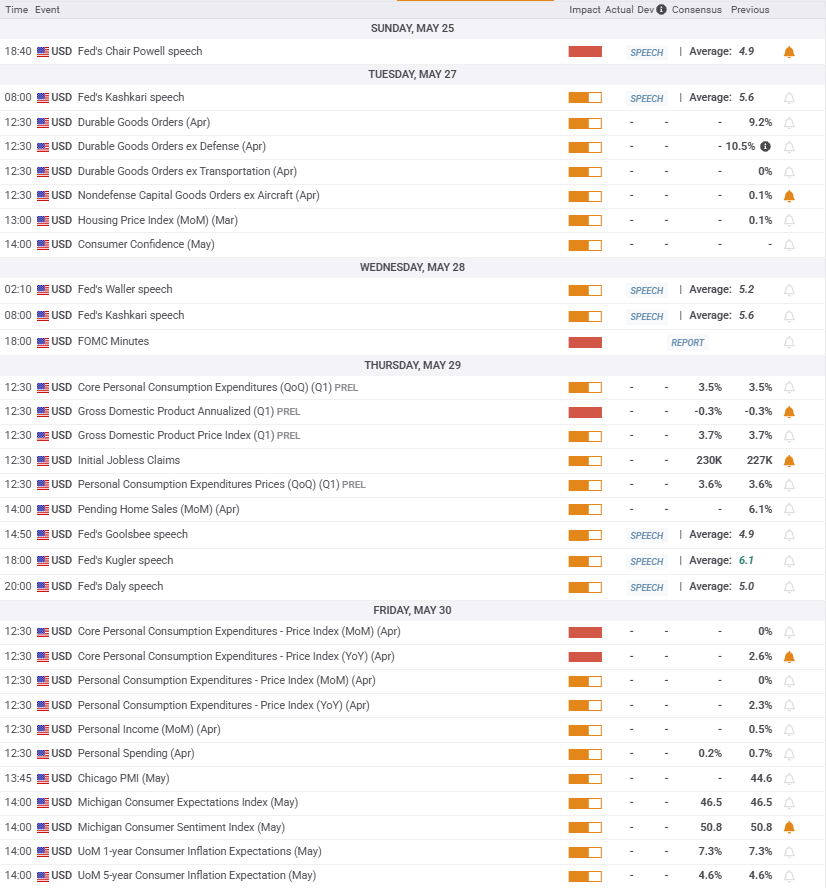
The US economic calendar will feature Durable Goods Orders data for April on Tuesday. On Wednesday, the Federal Reserve (Fed) will publish the minutes of the May policy meeting. Finally, the US Bureau of Economic Analysis will publish the Personal Consumption Expenditures (PCE) Price Index data, the Fed’s preferred gauge of inflation, on Friday.
According to the CME FedWatch Tool, markets are currently pricing in about a 27% probability of a 25 basis points (bps) rate cut in July. In case the monthly core PCE Price Index rises at a stronger pace than expected in April, the immediate market reaction could cause investors to lean toward a no change in the policy rate in July. In this scenario, the USD could gather strength and cause XAU/USD to stretch lower heading into the weekend.
The US Senate is expected to start discussions on the spending bill after the Memorial Day holiday on May 26 and vote on it before July 4. In case markets remain convinced that the Senate will approve the bill without significant changes to it, the USD could have a difficult time staging a steady recovery.
Meanwhile, headlines surrounding the US’ trade negotiations will be scrutinized. If the US fails to make progress in talks with major trading partners such as the EU and Japan, safe-haven flows could continue to dominate the action in financial markets and open the door for another leg higher in Gold. Additionally, a further escalation of tensions in the Middle East could remain supportive for the precious metal.
Gold technical analysis: Bulls return
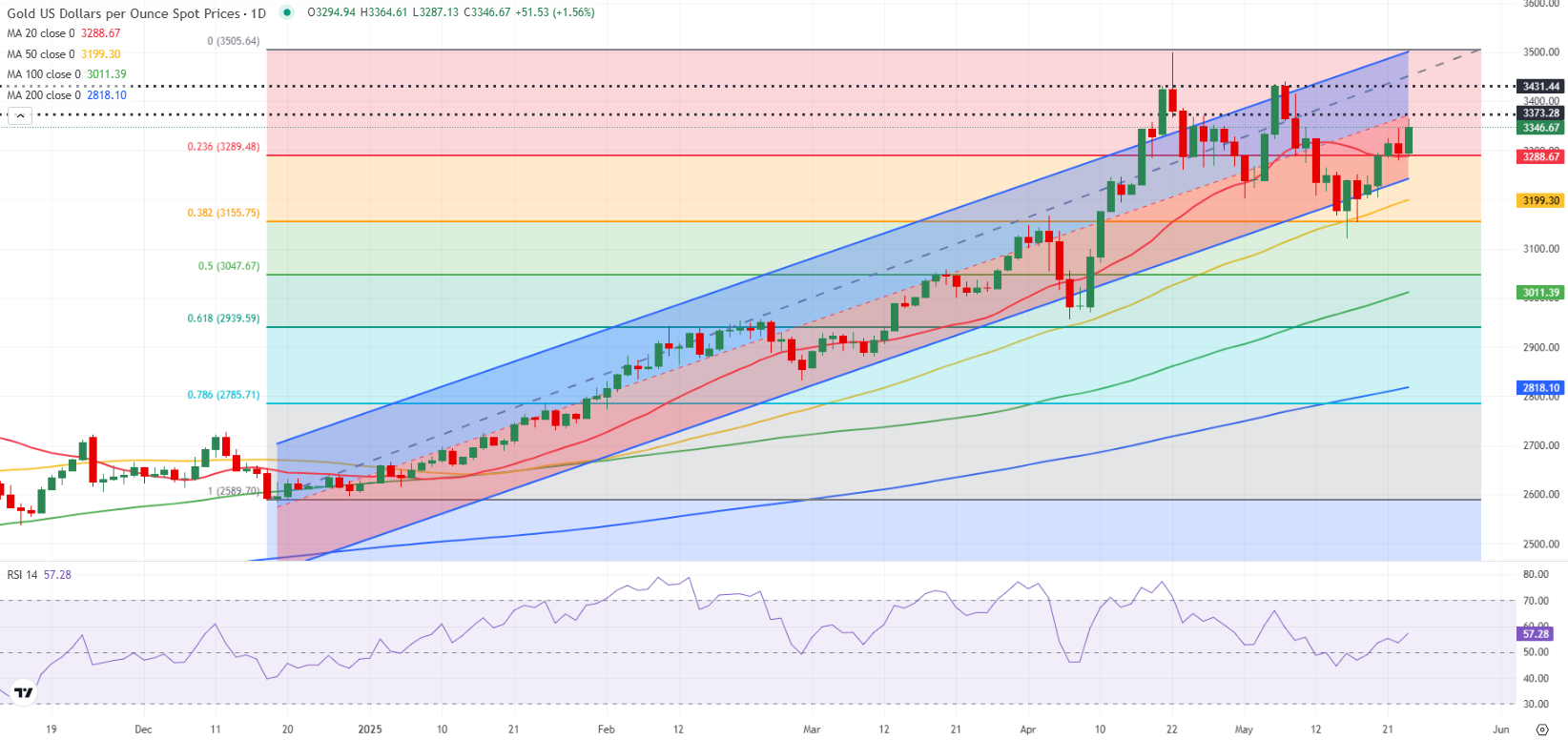
Gold returned with the ascending regression channel and closed the last three days above the 20-day Simple Moving Average (SMA), reflecting a bullish tilt in the near-term outlook. Additionally, the Relative Strength Index (RSI) indicator on the daily chart rose toward 60, reaffirming sellers’ hesitancy.
The mid-point of the ascending channel aligns as the next resistance level at $3,370 before $3,430 (static level) and $3,500 (all-time high). On the downside, first support could be spotted at the $3,290-$3,300 range (Fibonacci 23.6% retracement of the five-month-old uptrend, round level, 20-day SMA), $3,250 (lower limit of the ascending channel) and $3,200 (50-day SMA).
Tariffs FAQs
Tariffs are customs duties levied on certain merchandise imports or a category of products. Tariffs are designed to help local producers and manufacturers be more competitive in the market by providing a price advantage over similar goods that can be imported. Tariffs are widely used as tools of protectionism, along with trade barriers and import quotas.
Although tariffs and taxes both generate government revenue to fund public goods and services, they have several distinctions. Tariffs are prepaid at the port of entry, while taxes are paid at the time of purchase. Taxes are imposed on individual taxpayers and businesses, while tariffs are paid by importers.
There are two schools of thought among economists regarding the usage of tariffs. While some argue that tariffs are necessary to protect domestic industries and address trade imbalances, others see them as a harmful tool that could potentially drive prices higher over the long term and lead to a damaging trade war by encouraging tit-for-tat tariffs.
During the run-up to the presidential election in November 2024, Donald Trump made it clear that he intends to use tariffs to support the US economy and American producers. In 2024, Mexico, China and Canada accounted for 42% of total US imports. In this period, Mexico stood out as the top exporter with $466.6 billion, according to the US Census Bureau. Hence, Trump wants to focus on these three nations when imposing tariffs. He also plans to use the revenue generated through tariffs to lower personal income taxes.
