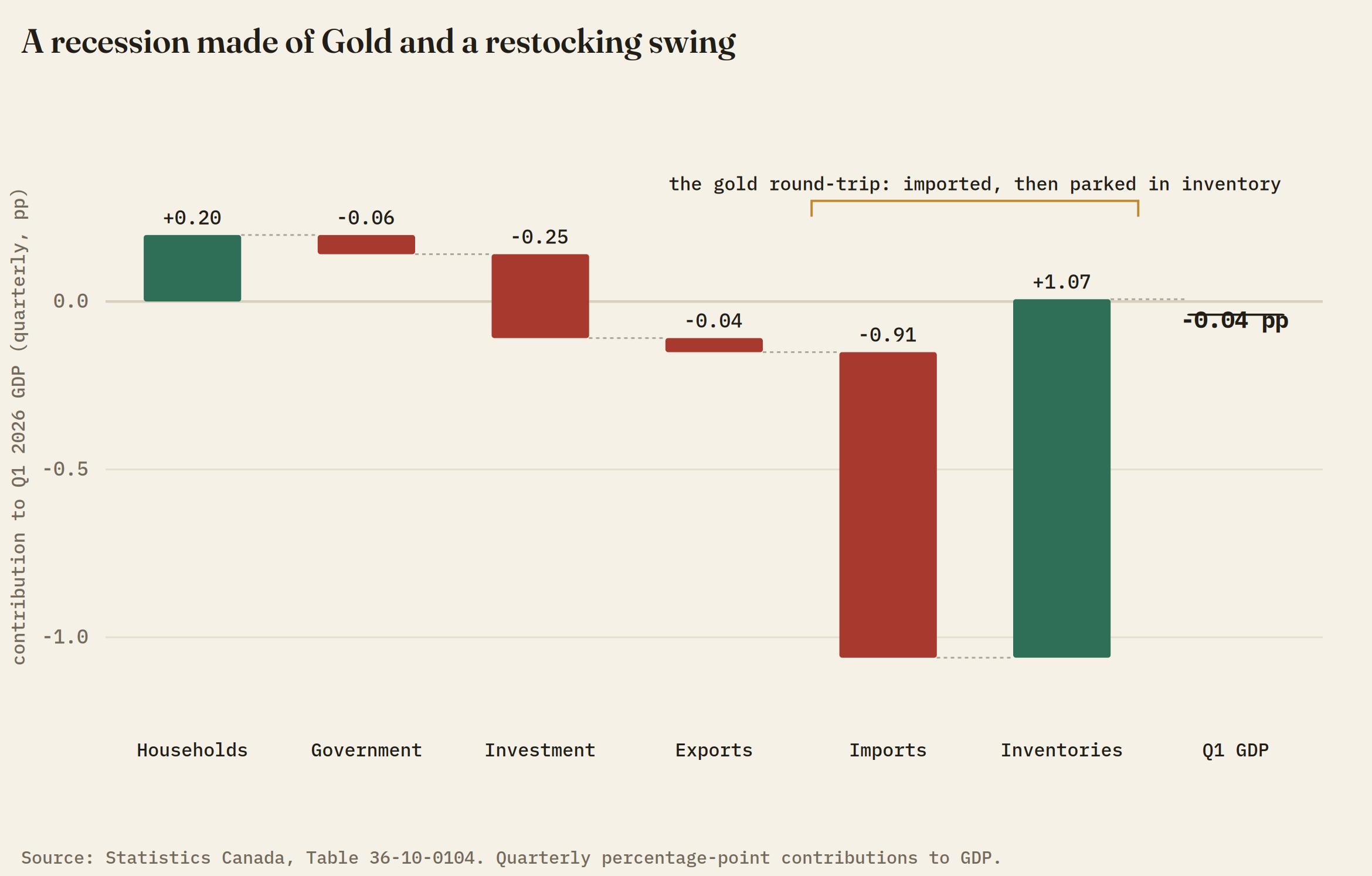
Statistics Canada (StatCan) handed the headline writers a gift and the analysts a headache. Real Gross Domestic Product (GDP) shrank 0.1% on an annualized basis in the first quarter, and with the fourth quarter of 2025 revised down to a 1.0% contraction, that is two negative quarters in a row, the textbook definition of a technical recession and Canada’s first since the pandemic. Cue the word that moves currencies.
Except this is about the flimsiest recession you will ever see called one. On a QoQ basis, the economy was essentially flat. The monthly data by industry actually points to mildly positive growth. Real GDP per head rose, because the country’s population shrank for a second straight quarter. The minus sign exists largely because annualizing magnifies a rounding-error quarter into something that sounds like a crisis.
So the headline manages to mislead in both directions at once. It overstates the shock, because the number is barely negative and the cause was mechanical. And it understates the weakness, because Canada’s real problems are older and quieter than any two-quarter window. The useful conclusion for anyone trading the Loonie falls out of that contradiction: the recession is not news.
The slow bleed has been visible for a year, and the currency has been pricing it the whole way. A recession label does not hand the market a fresh reason to sell what it has already been selling. The question worth answering is what moves the Loonie from here, and the answer is not StatCan. It is Oil, and it is the gap between the Bank of Canada (BoC) and a brand-new Federal Reserve (Fed).
A technical recession made of Gold and a shrinking country
Look at what actually produced the minus sign and the recession starts to dissolve. The single biggest drag was a surge in imports, and a remarkable share of that was Gold. A record wave of bullion buying flowed across the border and, by the accounting identities, subtracts directly from GDP. Strip out the precious-metal distortion and the restocking of inventories that ran alongside it, and the collapse largely evaporates; consumer spending actually rose on the quarter. This is not the signature of a demand bust. It is a quarter in which Canadians and institutions bought a lot of Gold and topped up their warehouses.
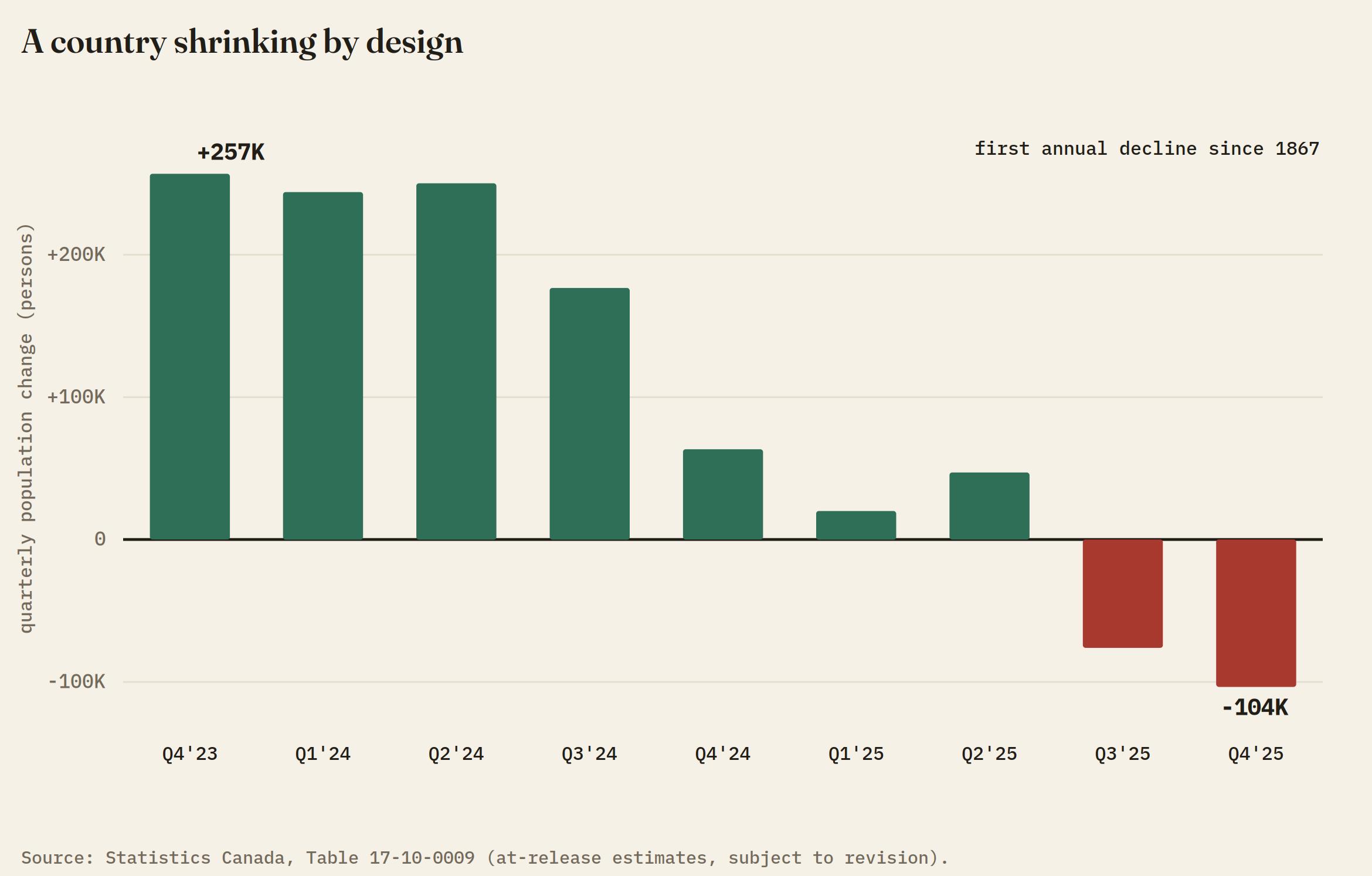
The second force is stranger and more consequential: Canada is shrinking. The population fell for two consecutive quarters, dropping by more than 100K in the final quarter of 2025 alone, and posting the first annual decline since Confederation in 1867. This was not an accident but a policy, a deliberate reversal of the immigration boom in which the government slashed the number of temporary residents, the study and work permit holders who had powered the population surge of recent years.
Here is why it matters for the recession label: those residents spend, so removing them lowers the level of aggregate output even as it lifts output per person. That is exactly the split the data shows, a smaller economy in total, a slightly richer one per head. Call it a recession if the arithmetic demands it, but it is a recession that arrives because the country chose to get smaller, not because households stopped spending.
None of which means Canada is healthy. The genuine soft spots are real, just older than two quarters: business investment fell for a fifth consecutive quarter as firms sat on their hands waiting for trade clarity, resale housing activity dropped nearly 10%, and the household savings rate slid to its lowest since early 2024 as families ran down their cushions to keep spending. That is the weakness worth worrying about, and tellingly it is not the part the recession headline is measuring.
Saved by Oil, sunk by Oil
The cruel joke buried in the Q1 data is that the thing tipping Canada into recession and the thing pulling it back out are the same barrel of Crude Oil. The Iran war drove Brent above $100 for most of the spring, and that energy shock fed the import bill and the investment freeze that hollowed out the quarter. Yet the rebound everyone now points to is oil-and-gas-led: StatCan’s early estimate has output bouncing 0.4% in April as the energy sector roared back, and economists were quick to call the downturn already over.
Here is the catch. Brent has since fallen around 17% in May, its worst month since 2020, and sits roughly 20% off its 2026 peak near $91. Washington and Tehran inch toward a 60-day ceasefire that would reopen the Strait of Hormuz, but that deal is now in doubt. The recovery engine is stalling at the exact moment it was supposed to rev up. For most of the world, a cheaper barrel is a gift. For a petro-economy whose second-quarter bounce was built on energy, it is the rug being pulled. Watch Brent, not the GDP vintage; the terms-of-trade hit is the live threat to the Loonie, and it is landing now.
The crash that clears the runway
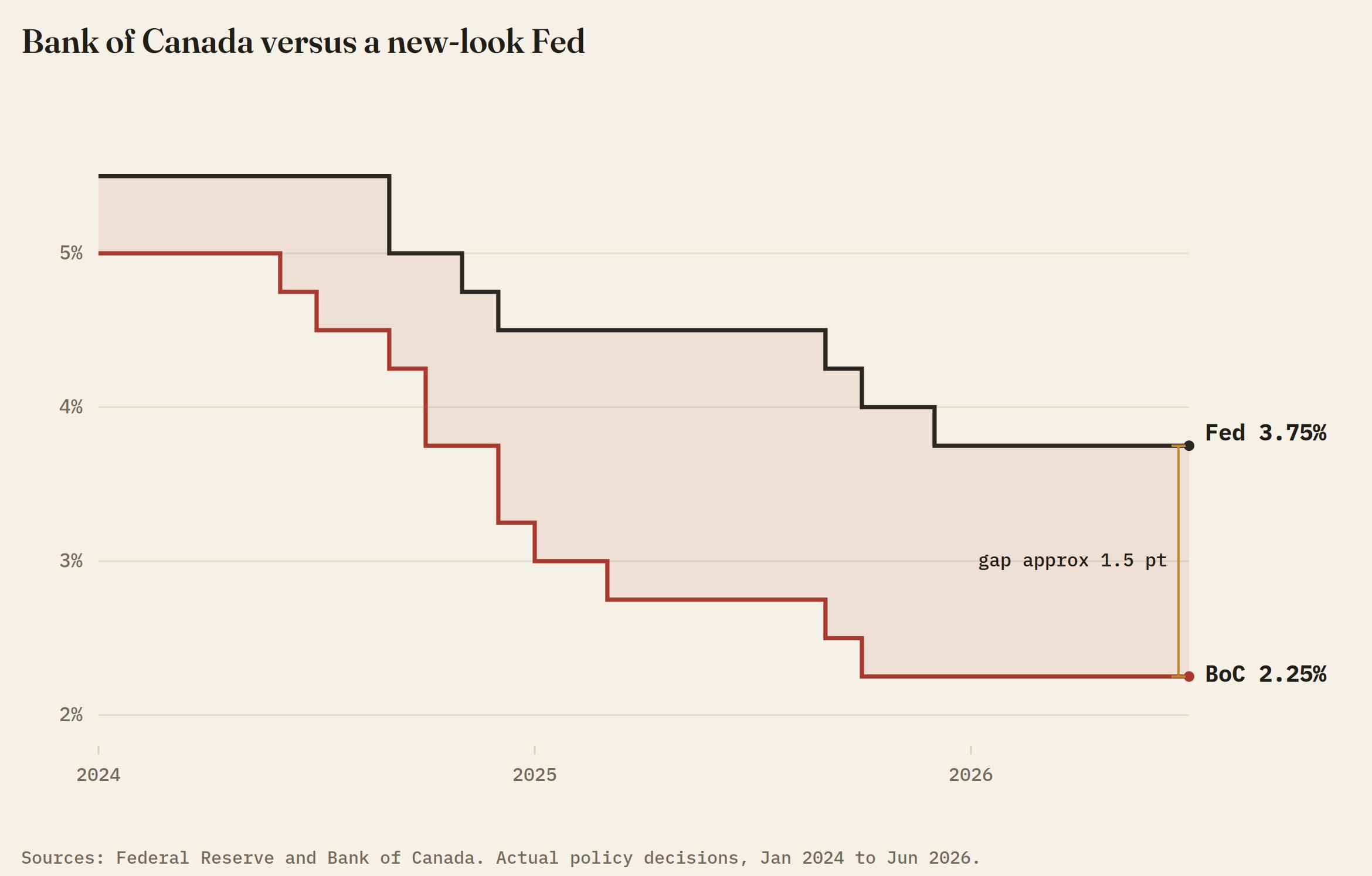
The Oil move matters even more for what it does to the Bank of Canada than for what it does to growth. The Bank has held its overnight rate at 2.25% since October, the end of a long easing cycle that took nine cuts off a 5% peak, and most analysts had pencilled that cycle in as finished.
For months the justification for sitting still was energy-driven inflation, which the Bank had upgraded to average above 2% this year. A recession alone was never going to force its hand. But strip out the Oil premium, and the inflation alibi goes with it. Suddenly, the Bank is staring at a contracting economy and fading price pressure at the same time, which is about as clean a permission slip to cut as a central banker ever gets. The BoC next meets on June 10 and is widely expected to hold, but the mix of a recession print and a crude collapse is exactly what reopens an easing cycle everyone thought was shut. Its own forecast of 1.2% growth for the year already looks unreachable.
Now set that against the other side of the pair, where the contrast is starker than the rate levels alone suggest. Kevin Warsh took the Fed Chair on May 22, and the so-called Warsh trade has firmed the US Dollar ever since — not because anyone expects him to hike, but because his signature project is shrinking the Fed’s roughly $6.7 trillion balance sheet.
Pulling liquidity out of the system is its own form of tightening, and markets have read his arrival as a reason for higher long-end yields and a firmer US Dollar, even as he talks eventually of lower policy rates. In the here and now, the fed funds rate is stuck at 3.50% to 3.75%, the Federal Open Market Committee (FOMC) is split between holding and hiking, and the man who used to run the place, Jerome Powell, is now a lame-duck governor pledging to keep quiet.
A Bank of Canada edging toward cuts against a Fed whose new Chair wants to drain liquidity is a rate gap set to widen from an already broad starting point, and a widening gap is the most dependable engine there is for a higher Loonie cross. That, not the recession headline, is the mechanism that sells the currency.
Trading it: Levels and triggers
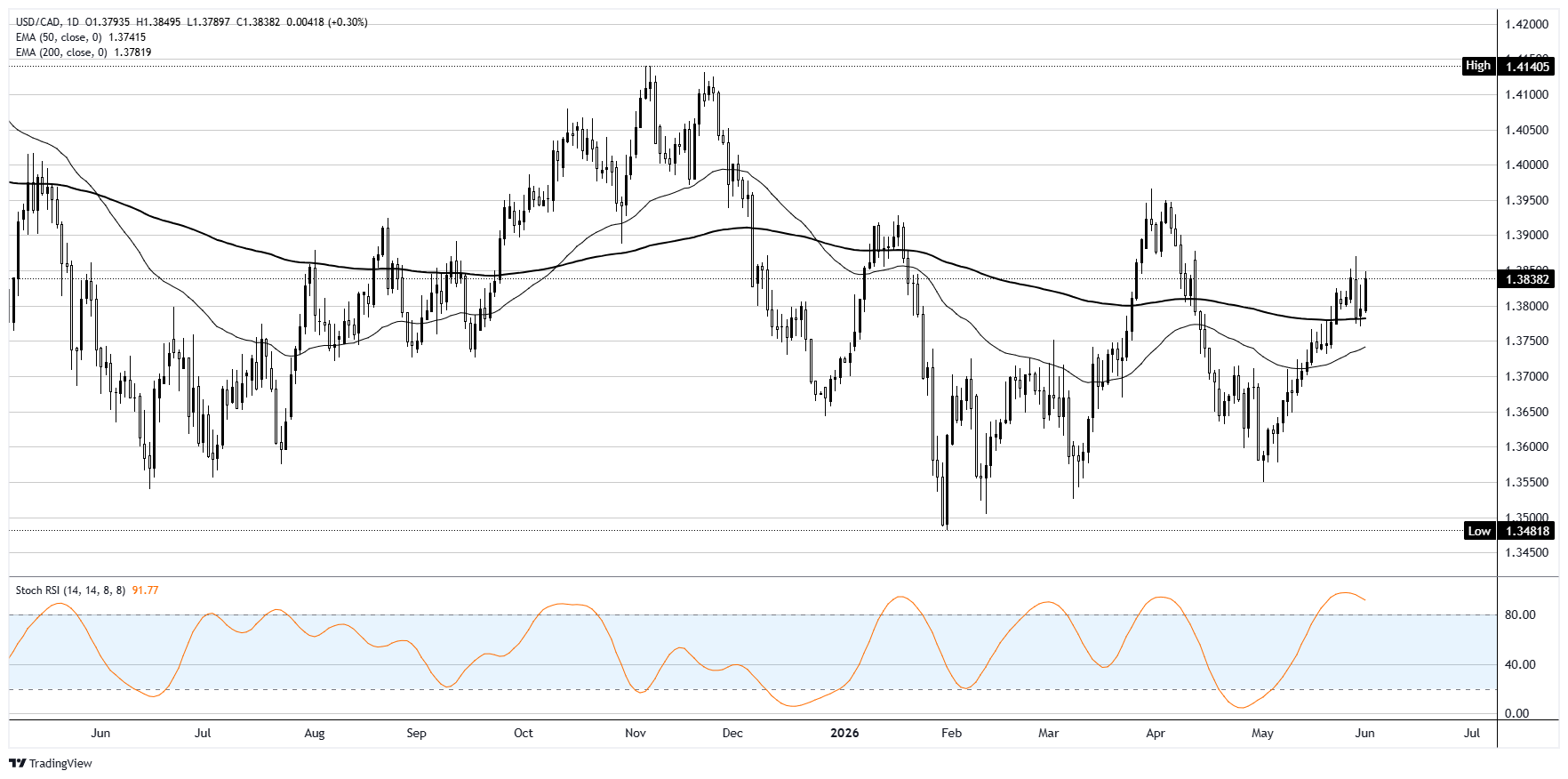
The chart backs the lean. USD/CAD has pushed back above the 1.3800 handle and reclaimed its 200 EMA at 1.3785, with the 50 EMA sitting just beneath at 1.3740 as the first cushion. The tape sits with the bulls: Oil lower, the rate gap widening, and price back above the moving average cluster.
The lean is long while 1.3785 holds on a closing basis; lose it and 1.3740 then 1.3700 come back into play. Two honest caveats temper the chase. The daily Stoch RSI is pinned near 92, deep into overbought, so buying 1.3800 here into a binary event is poor risk/reward. And the trade is crowded: the speculative crowd has been sitting heavily net short the Loonie, leveraged funds the better part of 40K contracts and asset managers short on top, so the easy money on this move has already been made and the pair is vulnerable to a squeeze if the data breaks the wrong way. The cleaner entry is a pullback into the 1.3740 to 1.3785 zone, or a confirmed close above 1.3850 that opens the door toward 1.3900 and the 1.4000 ceiling that has capped this pair for a year.
The trigger is the jobs data due 5 June at 12:30 GMT, when Canada’s employment report lands in the same minute as US Nonfarm Payrolls (NFP). A firm US number against soft Canadian employment is the mix that breaks 1.3850 and runs; the reverse, a weak NFP against strong Canadian data, is the line that tilts the pair back toward the EMAs, squeezes those shorts, and undercuts the whole long case. Frame the trade around that print, not around the recession that printed last week.
Which leaves the Loonie in a strange spot. The recession dominating the headlines is the part that matters least: half a Gold-import illusion, half a country shrinking itself by design. What will actually decide the next big figure, whether crude keeps bleeding and whether the Bank of Canada blinks before the Fed does, barely rates a mention. The bias is lower while Oil falls and the rate gap yawns.
But everyone can see it: the shorts are stacked, and the same cheap crude that threatens the Loonie’s terms of trade is also the thing that could let the Bank cut, stoke a genuine recovery, and prove this downturn was over before it was ever named. The bigger surprise from here might not be another leg down. It might be the bounce that catches a very crowded boat leaning the wrong way.
USD/CAD daily chart